Begin of page section:
Page sections:

  • Go to contents (Accesskey 1)
  • Go to position marker (Accesskey 2)
  • Go to main navigation (Accesskey 3)
  • Go to sub navigation (Accesskey 4)
  • Go to additional information (Accesskey 5)
  • Go to page settings (user/language) (Accesskey 8)
  • Go to search (Accesskey 9)

End of this page section. Go to overview of page sections

Begin of page section:
Page settings:

English en
Deutsch de
Search
Login

End of this page section. Go to overview of page sections

Begin of page section:
Search:

Search for details about Uni Graz
Close

End of this page section. Go to overview of page sections


Search

Begin of page section:
Main navigation:

Page navigation:

  • University

    University
    • About the University
    • Organisation
    • Faculties
    • Library
    • Working at University of Graz
    • Campus
    Developing solutions for the world of tomorrow - that is our mission. Our students and our researchers take on the great challenges of society and carry the knowledge out.
  • Research Profile

    Research Profile
    • Our Expertise
    • Research Questions
    • Research Portal
    • Promoting Research
    • Research Transfer
    • Ethics in Research
    • Commission for Scientific Integrity
    Scientific excellence and the courage to break new ground. Research at the University of Graz creates the foundations for making the future worth living.
  • Studies

    Studies
    • Prospective Students
    • Students
  • Community

    Community
    • International
    • Location
    • Research and Business
    • Alumni
    The University of Graz is a hub for international research and brings together scientists and business experts. Moreover, it fosters the exchange and cooperation in study and teaching.
  • Spotlight
Topics
  • Sustainable University
  • Researchers answer
  • Work for us
Close menu

End of this page section. Go to overview of page sections

Begin of page section:
You are here:

University of Graz Natural sciences News Auf Wegeners Spuren
  • About the faculty
  • Our research
  • Study Service
  • Dean's office
  • Personalities
  • Institute of Biology

End of this page section. Go to overview of page sections

Monday, 11 August 2014

Auf Wegeners Spuren

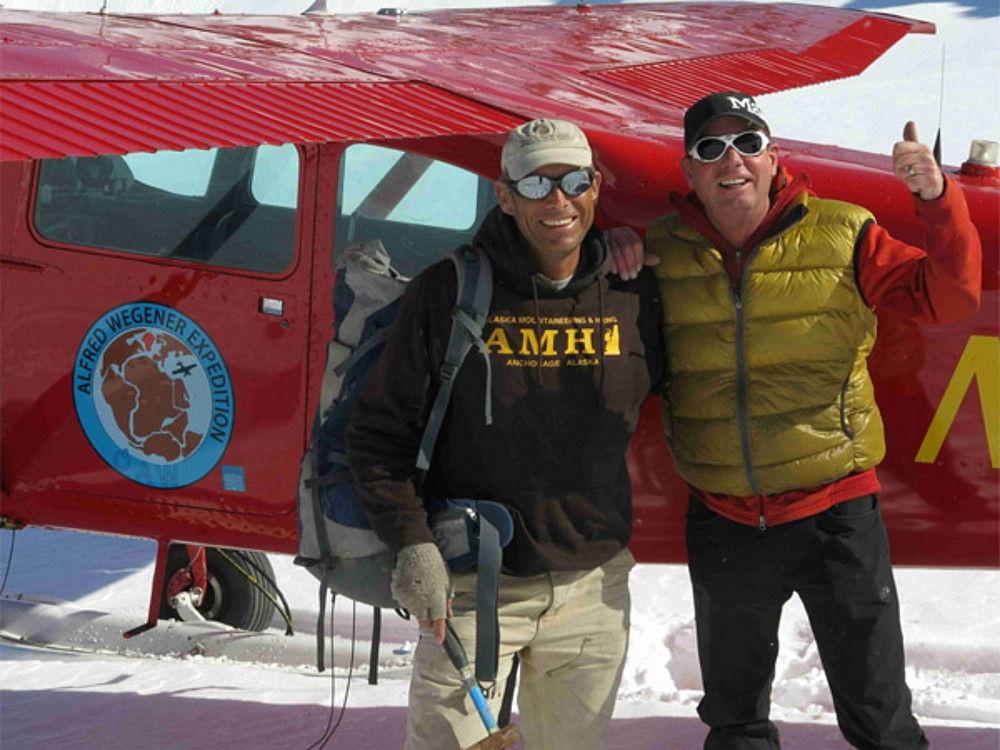
Kurt Stüwe mit seinem Piloten Paul Claus und einer umgebauten Cessna aus dem Jahr 1953: So begaben sich die beiden auf die Spuren von Alfred Wegener.

Kurt Stüwe mit seinem Piloten Paul Claus und einer umgebauten Cessna aus dem Jahr 1953: So begaben sich die beiden auf die Spuren von Alfred Wegener.

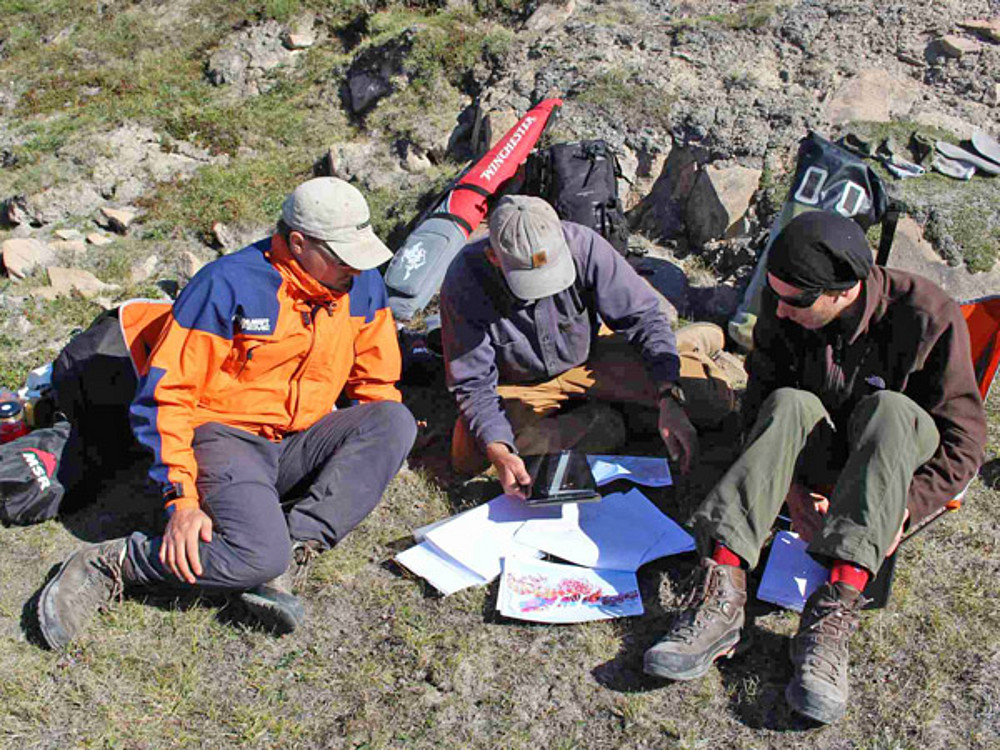
Stüwe instruiert seine Studenten Gerald Raab und Felix Rauschenbusch, die an einer Masterarbeit zu Ostgrönland arbeiten.

Stüwe instruiert seine Studenten Gerald Raab und Felix Rauschenbusch, die an einer Masterarbeit zu Ostgrönland arbeiten.

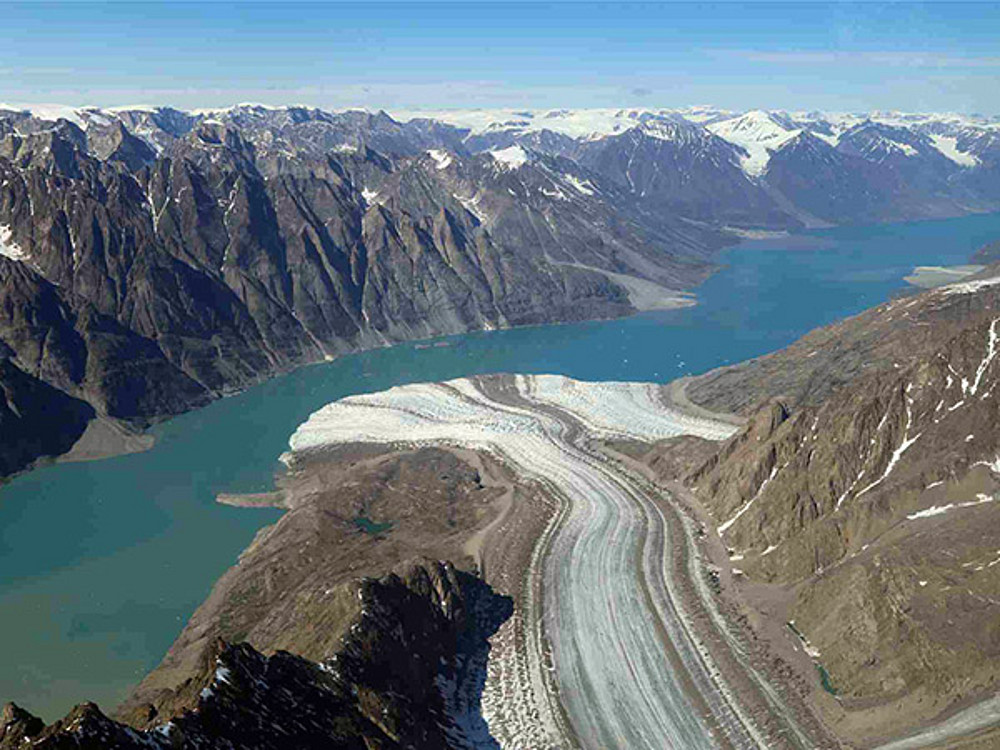
Aus der Vogelperspektive beobachtete das Duo beeindruckende Landschaften.

Aus der Vogelperspektive beobachtete das Duo beeindruckende Landschaften.

Erdwissenschafter Kurt Stüwe entdeckte auf Grönland-Expedition sogar den Schlitten des berühmten Forschers

Vor ziemlich genau hundert Jahren formulierte Alfred Wegener, ab 1924 Professor für Meteorologie und Geophysik an der Uni Graz, die Theorie der Kontinentalverschiebung, die ihm später zu Weltruhm verhalf. Der studierte Astronom, der sich später der Meteorologie zuwendete, unternahm 1906 und 1912 zwei große Expeditionen mach Grönland. Rund hundert Jahre später begab sich nun Kurt Stüwe, Erdwissenschafter an der Uni Graz, auf die Spuren des Pioniers. "Wir wollten erstens Spuren von Wegeners Unternehmungen finden - was erfreulicherweise gelang -, und zweitens geologische Proben für verschiedene Forschungsprojekte an Stellen entnehmen, wo bisher noch nie jemand hingekommen ist", berichtet der Forscher. Die abenteuerliche Reise unternahm er von Alaska aus gemeinsam mit dem Piloten und Schilodge-Besitzer Paul Claus in einem eigens umgebauten Kleinflugzeug, das auf Stränden, in der Tundra und sogar auf Eis landen kann.

"Mit Karten über Wegeners Expeditionen auf den Knien flogen wir knapp über dem Boden hunderte Kilometer Küstenlinie ab, um Relikte zu finden - und stießen tatsächlich auf einen Schlitten, den er bei seiner Expedition 1912 verwendet hatte", erzählt Stüwe begeistert. Die gesammelten Gesteinsproben werden an verschiedenen europäischen Universitäten analysiert.

Einen kleinen Teil der Tour machten auch die Grazer Studenten Gerald Raab und Felix Rauschenbusch mit, die sich im Rahmen ihres Masterprojekts mit Ostgrönland befassen. Für die Finanzierung der Reise konnten Werner Piller und Kurt Stüwe die Österreichische Akademie der Wissenschaften gewinnen, im nächsten Jahr wird ein Buch zur Gedenkexpedition erscheinen.

created by Dagmar Eklaude

Related news

Learning better: Can science experiments in group settings help children with autism?

How can pupils with autism spectrum disorder (ASD) have positive learning experiences and improve their social skills? Researchers at the University of Graz are investigating how science experiments in group settings can contribute to this. Initial results from the project, which is funded by the Austrian Science Fund FWF, show that children react differently depending on the kind of neurodiversity, but that experimentation classes with the right setting definitely have potential. "Pupils with ASD can do more than is currently expected of them in many cases," says project leader Uwe Simon.

Sustainability Award 2024 for two projects of the University of Graz

How do major international conferences reduce their carbon footprint? And what can maths lessons contribute to education for sustainable development? Two questions that were answered at the University of Graz. The corresponding projects were awarded the Sustainability Award 2024 in silver on 26 November in Vienna. This award for Austria's universities and colleges is presented by the Ministry of Science and the Ministry of Climate Protection.

Bees under observation: University of Graz provides unprecedented insights into the hive

What is going on in the combs? How many eggs is the queen laying? How much honey is there? Autonomous robots and AI algorithms provide important data and high-resolution real-time images from inside a beehive. "As part of an international team, we have developed a game-changer technology for a new type of digitalised behavioural research," reports biologist Thomas Schmickl from the Artifical Life Lab at the University of Graz. The publication, which has just appeared as the cover story in the journal "Science Robotics", describes the wealth of information that can be obtained from this unique research facility.

Research for healthy aging: FWF funds Cluster of Excellence "MetAGE" with 18 million euros

Six researchers from the Field of Excellence "BioHealth" at the University of Graz, together with colleagues from the Medical Universities of Graz and Vienna, have acquired an FWF-funded "Cluster of Excellence". Now a newly formed center of excellence will be created under the leadership of the University of Graz. The aim is to gain a better understanding of healthy aging. The findings will flow directly into clinical research.

Begin of page section:
Additional information:

University of Graz
Universitaetsplatz 3
8010 Graz
Austria
  • Contact
  • Web Editors
  • Moodle
  • UNIGRAZonline
  • Imprint
  • Data Protection Declaration
  • Accessibility Declaration
Weatherstation
Uni Graz

End of this page section. Go to overview of page sections

End of this page section. Go to overview of page sections

Begin of page section:

End of this page section. Go to overview of page sections