Begin of page section:
Page sections:

  • Go to contents (Accesskey 1)
  • Go to position marker (Accesskey 2)
  • Go to main navigation (Accesskey 3)
  • Go to sub navigation (Accesskey 4)
  • Go to additional information (Accesskey 5)
  • Go to page settings (user/language) (Accesskey 8)
  • Go to search (Accesskey 9)

End of this page section. Go to overview of page sections

Begin of page section:
Page settings:

English en
Deutsch de
Search
Login

End of this page section. Go to overview of page sections

Begin of page section:
Search:

Search for details about Uni Graz
Close

End of this page section. Go to overview of page sections


Search

Begin of page section:
Main navigation:

Page navigation:

  • University

    University
    • About the University
    • Organisation
    • Faculties
    • Library
    • Working at University of Graz
    • Campus
    Developing solutions for the world of tomorrow - that is our mission. Our students and our researchers take on the great challenges of society and carry the knowledge out.
  • Research Profile

    Research Profile
    • Our Expertise
    • Research Questions
    • Research Portal
    • Promoting Research
    • Research Transfer
    • Ethics in Research
    • Commission for Scientific Integrity
    Scientific excellence and the courage to break new ground. Research at the University of Graz creates the foundations for making the future worth living.
  • Studies

    Studies
    • Prospective Students
    • Students
  • Community

    Community
    • International
    • Location
    • Research and Business
    • Alumni
    The University of Graz is a hub for international research and brings together scientists and business experts. Moreover, it fosters the exchange and cooperation in study and teaching.
  • Spotlight
Topics
  • Sustainable University
  • Researchers answer
  • Work for us
Close menu

End of this page section. Go to overview of page sections

Begin of page section:
You are here:

University of Graz Natural sciences News Forum für Spitzenforschung
  • About the faculty
  • Our research
  • Study Service
  • Dean's office
  • Personalities
  • Institute of Biology

End of this page section. Go to overview of page sections

Thursday, 13 March 2014

Forum für Spitzenforschung

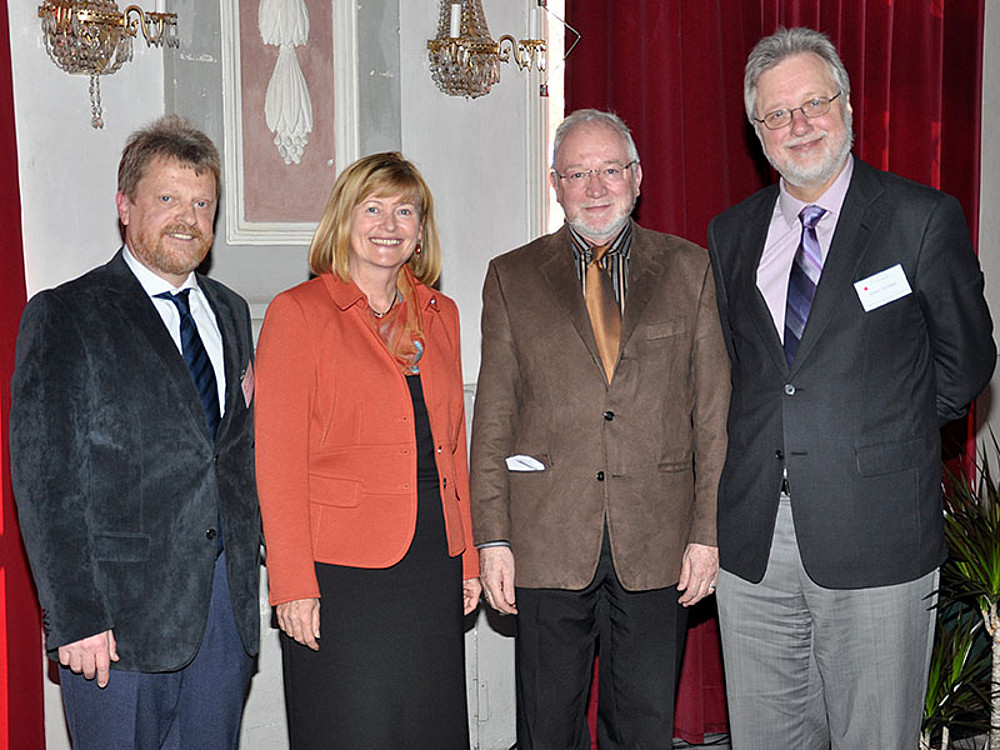
Die wissenschaftlichen Leiter der Konferenz, Sepp D. Kohlwein (l.) und Rudolf Zechner (r.), mit Rektorin Christa Neuper und Dekan Karl Crailsheim

Die wissenschaftlichen Leiter der Konferenz, Sepp D. Kohlwein (l.) und Rudolf Zechner (r.), mit Rektorin Christa Neuper und Dekan Karl Crailsheim

5th International Graz Symposium on Lipid and Membrane Biology

Fettstoffwechselstörungen, die zu Krankheiten wie Diabetes Typ 2, Atherosklerose oder Adipositas führen, nehmen weltweit zu. Um geeignete Therapiemöglichkeiten entwickeln zu können, ist es notwendig, die molekularen Mechanismen des Fettstoffwechsels zu verstehen. In dem von der Karl-Franzens-Universität Graz koordinierten Spezialforschungsbereich (SFB) LIPOTOX untersuchen WissenschafterInnen der Uni Graz gemeinsam mit Arbeitsgruppen der Medizinischen Universität und der TU Graz die fehlgesteuerte Aufnahme und Produktion von Fettsäuren und Lipiden, die zur Bildung (lipo)toxischer Substanzen führen. Dieses als Lipotoxizität bezeichnete Phänomen führt zu einer Dysfunktion von Zellen und Geweben und kann im Zelltod enden.

Von 13. bis 15. März 2014 veranstaltet das Institut für Molekulare Biowissenschaften der Uni Graz im Rahmen des SFB bereits zum fünften Mal das „International Graz Symposium on Lipid and Membrane Biology“, zu dem SpitzenforscherInnen aus aller Welt angereist sind.


Im Rahmen des SFB LIPOTOX wurden in den letzten Jahren grundlegende neue Erkenntnisse gewonnen, die international Aufmerksamkeit erregten. „Der Spezialforschungsbereich ist ein leuchtendes Beispiel für die erfolgreiche Kooperation der Karl-Franzens-Universität, der Medizinischen Universität und der TU Graz und hat wesentlich dazu beigetragen, Graz zu einem europäischen Zentrum der Lipidforschung zu machen“, unterstrich Rektorin Christa Neuper in ihren Grußworten zur Eröffnung der Konferenz. Der SFB, der vom Österreichischen Wissenschaftsfonds FWF, dem Land Steiermark und der Stadt Graz gefördert wird, habe auch den Weg für die Netzwerkinitiative „BioTechMed-Graz“ geebnet, welche die drei Grazer Universitäten an der Schnittstelle von Biomedizinischen Grundlagen, Technologischen Entwicklungen und Medizinischer Anwendung mit dem Ziel einer gemeinsamen Forschung für Gesundheit zusammenführt.

Univ.-Prof. Dr. Karl Crailsheim, Dekan der Naturwissenschaftlichen Fakultät der Uni Graz, hob die Bedeutung der vom FWF geförderten Spezialforschungsbereiche für die Universitäten in Österreich hervor und betonte im Bezug auf LIPOTOX: „Sie sind für uns ein Argument, mehr Geld für Forschung zu bekommen.“


Im Rahmen des International Graz Symposium on Lipid and Membrane Biology warden aktuelle Entwicklungen in diesem Wissenschaftsgebiet diskutiert. Die PlenarsprecherInnen aus Europa, den USA, Kanada und Australien spannen in ihren Vorträgen den Bogen von der Erforschung fettgesteuerter zellulärer Signalprozesse in Modellorganismen bis hin zu biomedizinischen und pathobiologischen Untersuchungen im Menschen.

>> nähere Informationen zum Programm

created by Gudrun Pichler

Related news

Learning better: Can science experiments in group settings help children with autism?

How can pupils with autism spectrum disorder (ASD) have positive learning experiences and improve their social skills? Researchers at the University of Graz are investigating how science experiments in group settings can contribute to this. Initial results from the project, which is funded by the Austrian Science Fund FWF, show that children react differently depending on the kind of neurodiversity, but that experimentation classes with the right setting definitely have potential. "Pupils with ASD can do more than is currently expected of them in many cases," says project leader Uwe Simon.

Sustainability Award 2024 for two projects of the University of Graz

How do major international conferences reduce their carbon footprint? And what can maths lessons contribute to education for sustainable development? Two questions that were answered at the University of Graz. The corresponding projects were awarded the Sustainability Award 2024 in silver on 26 November in Vienna. This award for Austria's universities and colleges is presented by the Ministry of Science and the Ministry of Climate Protection.

Bees under observation: University of Graz provides unprecedented insights into the hive

What is going on in the combs? How many eggs is the queen laying? How much honey is there? Autonomous robots and AI algorithms provide important data and high-resolution real-time images from inside a beehive. "As part of an international team, we have developed a game-changer technology for a new type of digitalised behavioural research," reports biologist Thomas Schmickl from the Artifical Life Lab at the University of Graz. The publication, which has just appeared as the cover story in the journal "Science Robotics", describes the wealth of information that can be obtained from this unique research facility.

Research for healthy aging: FWF funds Cluster of Excellence "MetAGE" with 18 million euros

Six researchers from the Field of Excellence "BioHealth" at the University of Graz, together with colleagues from the Medical Universities of Graz and Vienna, have acquired an FWF-funded "Cluster of Excellence". Now a newly formed center of excellence will be created under the leadership of the University of Graz. The aim is to gain a better understanding of healthy aging. The findings will flow directly into clinical research.

Begin of page section:
Additional information:

University of Graz
Universitaetsplatz 3
8010 Graz
Austria
  • Contact
  • Web Editors
  • Moodle
  • UNIGRAZonline
  • Imprint
  • Data Protection Declaration
  • Accessibility Declaration
Weatherstation
Uni Graz

End of this page section. Go to overview of page sections

End of this page section. Go to overview of page sections

Begin of page section:

End of this page section. Go to overview of page sections