Begin of page section:
Page sections:

  • Go to contents (Accesskey 1)
  • Go to position marker (Accesskey 2)
  • Go to main navigation (Accesskey 3)
  • Go to sub navigation (Accesskey 4)
  • Go to additional information (Accesskey 5)
  • Go to page settings (user/language) (Accesskey 8)
  • Go to search (Accesskey 9)

End of this page section. Go to overview of page sections

Begin of page section:
Page settings:

English en
Deutsch de
Search
Login

End of this page section. Go to overview of page sections

Begin of page section:
Search:

Search for details about Uni Graz
Close

End of this page section. Go to overview of page sections


Search

Begin of page section:
Main navigation:

Page navigation:

  • University

    University
    • About the University
    • Organisation
    • Faculties
    • Library
    • Working at University of Graz
    • Campus
    Developing solutions for the world of tomorrow - that is our mission. Our students and our researchers take on the great challenges of society and carry the knowledge out.
  • Research Profile

    Research Profile
    • Our Expertise
    • Research Questions
    • Research Portal
    • Promoting Research
    • Research Transfer
    • Ethics in Research
    Scientific excellence and the courage to break new ground. Research at the University of Graz creates the foundations for making the future worth living.
  • Studies

    Studies
    • Prospective Students
    • Students
  • Community

    Community
    • International
    • Location
    • Research and Business
    • Alumni
    The University of Graz is a hub for international research and brings together scientists and business experts. Moreover, it fosters the exchange and cooperation in study and teaching.
  • Spotlight
Topics
  • Sustainable University
  • Researchers answer
  • Work for us
Close menu

End of this page section. Go to overview of page sections

Begin of page section:
You are here:

University of Graz Natural sciences News Geringe Winterverluste von Bienenvölkern
  • About the faculty
  • Our research
  • Study Service
  • Dean's office
  • Personalities
  • Institute of Biology

End of this page section. Go to overview of page sections

Tuesday, 24 May 2016

Geringe Winterverluste von Bienenvölkern

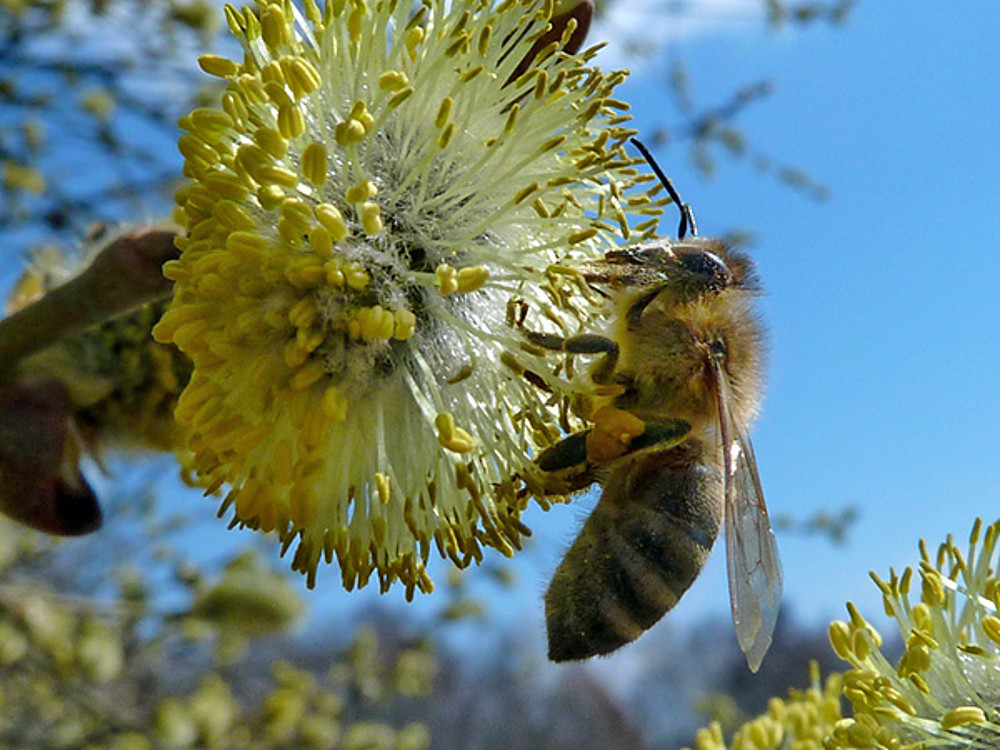
Im Winter 2015/16 verzeichneten die österreichischen ImkerInnen nur geringe Verluste an Bienenvölkern. Foto: Dr. Klaus-Uwe Gerhardt/pixelio.de

Im Winter 2015/16 verzeichneten die österreichischen ImkerInnen nur geringe Verluste an Bienenvölkern. Foto: Dr. Klaus-Uwe Gerhardt/pixelio.de

Zoologen der Uni Graz präsentieren Ergebnisse der aktuellen Erhebung

Das Forschungsprojekt „Zukunft Biene“ (2014–2017) hat die Untersuchung der Bienengesundheit in Österreich zum Ziel. Zoologen der Universität Graz präsentieren nun die Ergebnisse der Überwinterungsverluste, die im Rahmen der zum neunten Mal stattfindenden Erhebung von 1289 Imkereien gemeldet wurden. Diese hatten insgesamt 23.418 Bienenvölker eingewintert. Die Verlustrate betrug 8,1 Prozent im Winter 2015/16 (mit einem Vertrauensbereich von 7,4-8,8 Prozent).

„Unsere Ergebnisse sind valid, beruhen auf etwa fünf Prozent der österreichischen Bienenvölker und sind von der Methodik her vergleichbar mit den Ergebnissen anderer Länder“, so Projektleiter Univ.-Prof. Dr. Karl Crailsheim. Für eine genaue Risikoanalyse werden die österreichischen Datensätze, wie bereits in den Vorjahren, gemeinsam mit jenen aus weiteren europäischen Staaten statistisch ausgewertet und zu einem späteren Zeitpunkt publiziert. Eine detaillierte Analyse der österreichischen Ergebnisse des Winters 2014/15, in dem mit 28,4 Prozent sehr hohe Verluste verzeichnet wurden, liegt im zweiten Zwischenbericht des Projektes „Zukunft Biene“ auch online vor.

Im Rahmen des vom Bundesministerium für Land- und Forstwirtschaft, Umwelt und Wasserwirtschaft (BMLFUW), der Imkerei-Dachorganisation „Biene Österreich“ und den Bundesländern finanzierten Projektes „Zukunft Biene“ wurde außerdem eine Beobachtungsstudie durchgeführt, mit Besuchen und Probenahmen an über ganz Österreich verteilten Bienenständen vor und nach der diesjährigen Überwinterung. Erste Auswertungen zu Winterverlusten der an dieser Studie teilnehmenden Betriebe bestätigen die geringe Wintersterblichkeit: 185 Betriebe mit 12.489 eingewinterten Völkern verzeichneten einen Verlust von 8,6 Prozent.

Ein weiteres Ziel ist es, Informationen zum Vorkommen der wichtigsten Bienenkrankheiten zu erhalten und den Befall mit der parasitischen Varroa-Milbe vor der Haupt- und Restentmilbung zu erfassen. Daran anschließend erfolgen bei einem Teil der entnommenen Proben Analysen auf den Darmzellparasiten Nosema, auf einige Bienenviren und auf Chemikalien-Rückstände, um nachträglich mögliche Zusammenhänge mit aufgetretenen Winterverlusten zu untersuchen.

Wintersterblichkeit von Honigbienen 2015/16 (Stand: 24.5.2016):

Verlustrate %
(95 % Vertrauensbereich)
Teilnehmende
Imkereien
Betreute Bienenvölker
Österreich8,1 (7,4-8,8)128923.418
Burgenland11,0 (6,7-17,6)34564
Kärnten6,5 (5,4-7,9)1673954
Niederösterreich11,5 (9,8-13,5)3645436
Oberösterreich6,8 (5,5-8,4)2244650
Salzburg6,1 (4,1-9,1)691329
Steiermark8,7 (7,0-10,6)1903788
Tirol5,1 (3,7-6,9)1502619
Vorarlberg5,8 (3,7-9,1)50599
Wien11,5 (7,2-17,8)41479


Wintersterblichkeit von Honigbienen in Österreich seit 2007/08:

JahrVerlustrate %
2007/0813,3
2008/099,3
2009/1014,7
2010/1116,4
2011/1225,9
2012/1317,3
2013/1412,8
2014/1528,4
2015/168,1

AutorInnen der Presseaussendung:
Univ.-Prof. Dr. Karl Crailsheim, Institut für Zoologie, Universität Graz
Dr. Robert Brodschneider, Institut für Zoologie, Universität Graz
Dr. Rudolf Moosbeckhofer, Institut für Saat- und Pflanzgut, Pflanzenschutzdienst und Bienen,
Abt. Bienenkunde und Bienenschutz, AGES
Dr. Linde Morawetz, Institut für Saat- und Pflanzgut, Pflanzenschutzdienst und Bienen,
Abt. Bienenkunde und Bienenschutz, AGES

Weiterführende Informationen:
www.Zukunft-Biene.at
www.Bienenstand.at

COLOSS:
Diese Untersuchung wurde nach Standards der internationalen Non-Profit-Vereinigung COLOSS (Prevention of honey bee colony losses www.coloss.org) durchgeführt.

created by Gudrun Pichler

Related news

Learning better: Can science experiments in group settings help children with autism?

How can pupils with autism spectrum disorder (ASD) have positive learning experiences and improve their social skills? Researchers at the University of Graz are investigating how science experiments in group settings can contribute to this. Initial results from the project, which is funded by the Austrian Science Fund FWF, show that children react differently depending on the kind of neurodiversity, but that experimentation classes with the right setting definitely have potential. "Pupils with ASD can do more than is currently expected of them in many cases," says project leader Uwe Simon.

Sustainability Award 2024 for two projects of the University of Graz

How do major international conferences reduce their carbon footprint? And what can maths lessons contribute to education for sustainable development? Two questions that were answered at the University of Graz. The corresponding projects were awarded the Sustainability Award 2024 in silver on 26 November in Vienna. This award for Austria's universities and colleges is presented by the Ministry of Science and the Ministry of Climate Protection.

Bees under observation: University of Graz provides unprecedented insights into the hive

What is going on in the combs? How many eggs is the queen laying? How much honey is there? Autonomous robots and AI algorithms provide important data and high-resolution real-time images from inside a beehive. "As part of an international team, we have developed a game-changer technology for a new type of digitalised behavioural research," reports biologist Thomas Schmickl from the Artifical Life Lab at the University of Graz. The publication, which has just appeared as the cover story in the journal "Science Robotics", describes the wealth of information that can be obtained from this unique research facility.

Research for healthy aging: FWF funds Cluster of Excellence "MetAGE" with 18 million euros

Six researchers from the Field of Excellence "BioHealth" at the University of Graz, together with colleagues from the Medical Universities of Graz and Vienna, have acquired an FWF-funded "Cluster of Excellence". Now a newly formed center of excellence will be created under the leadership of the University of Graz. The aim is to gain a better understanding of healthy aging. The findings will flow directly into clinical research.

Begin of page section:
Additional information:

University of Graz
Universitaetsplatz 3
8010 Graz
Austria
  • Contact
  • Web Editors
  • Moodle
  • UNIGRAZonline
  • Imprint
  • Data Protection Declaration
  • Accessibility Declaration
Weatherstation
Uni Graz

End of this page section. Go to overview of page sections

End of this page section. Go to overview of page sections

Begin of page section:

End of this page section. Go to overview of page sections