Begin of page section:
Page sections:

  • Go to contents (Accesskey 1)
  • Go to position marker (Accesskey 2)
  • Go to main navigation (Accesskey 3)
  • Go to sub navigation (Accesskey 4)
  • Go to additional information (Accesskey 5)
  • Go to page settings (user/language) (Accesskey 8)
  • Go to search (Accesskey 9)

End of this page section. Go to overview of page sections

Begin of page section:
Page settings:

English en
Deutsch de
Search
Login

End of this page section. Go to overview of page sections

Begin of page section:
Search:

Search for details about Uni Graz
Close

End of this page section. Go to overview of page sections


Search

Begin of page section:
Main navigation:

Page navigation:

  • University

    University
    • About the University
    • Organisation
    • Faculties
    • Library
    • Working at University of Graz
    • Campus
    Developing solutions for the world of tomorrow - that is our mission. Our students and our researchers take on the great challenges of society and carry the knowledge out.
  • Research Profile

    Research Profile
    • Our Expertise
    • Research Questions
    • Research Portal
    • Promoting Research
    • Research Transfer
    • Ethics in Research
    • Commission for Scientific Integrity
    Scientific excellence and the courage to break new ground. Research at the University of Graz creates the foundations for making the future worth living.
  • Studies

    Studies
    • Prospective Students
    • Students
  • Community

    Community
    • International
    • Location
    • Research and Business
    • Alumni
    The University of Graz is a hub for international research and brings together scientists and business experts. Moreover, it fosters the exchange and cooperation in study and teaching.
  • Spotlight
Topics
  • Sustainable University
  • Researchers answer
  • Work for us
Close menu

End of this page section. Go to overview of page sections

Begin of page section:
You are here:

University of Graz Natural sciences News Grün und günstig
  • About the faculty
  • Our research
  • Study Service
  • Dean's office
  • Personalities
  • Institute of Biology

End of this page section. Go to overview of page sections

Monday, 19 May 2014

Grün und günstig

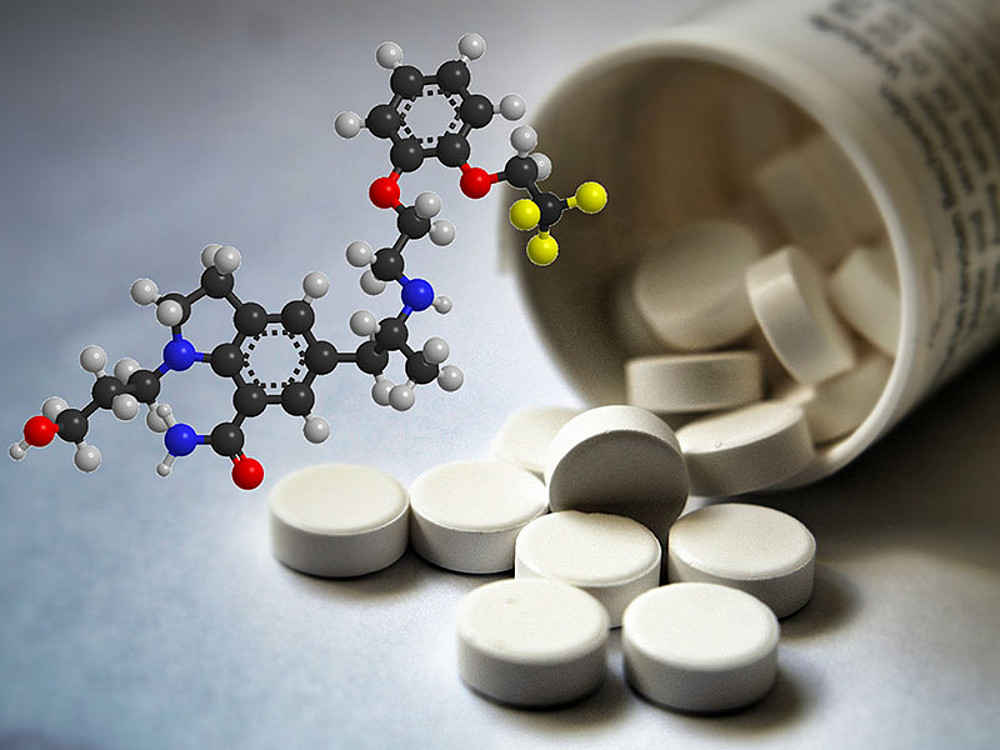
Struktur des Wirkstoffs Silodosin. Foto: Katharina Bregulla/<a href="http://www.pixelio.de">pixelio.de</a>

Struktur des Wirkstoffs Silodosin. Foto: Katharina Bregulla/<a href="http://www.pixelio.de">pixelio.de</a>

Grazer ChemikerInnen entwickeln umweltfreundliche Methode zur Herstellung eines „Männermedikaments“

Die Erzeugung von Medikamenten ist meist aufwändig und teuer. Um die Produktion zu optimieren, sucht die Forschung nach immer effizienteren Wegen der Wirkstoffgewinnung. Höchst erfolgreich ist darin Univ.-Prof. Dr. Wolfgang Kroutil vom Institut für Chemie der Karl-Franzens-Universität Graz: In einem Kooperationsprojekt zwischen dem Austrian Center of Industrial Biotechnology (ACIB), dem Pharmaunternehmen Sandoz und der Karl-Franzens-Universität Graz haben Kroutil und sein Team eine neue Methode zur kostengünstigen und umweltfreundlichen Synthese von Silodosin entwickelt. Das Medikament spielt eine wichtige Rolle in der Behandlung von Störungen beim Harnlassen durch Prostata-Vergrößerung – ein Problem, das mehr als 90 Prozent aller Männer über 85 Jahre betrifft.


„Wir haben ein höchst effizientes Verfahren zur Herstellung von Silodosin entdeckt. Es spart Zeit, Geld und Ressourcen und ist äußerst umweltfreundlich“, freut sich Wolfgang Kroutil. „Das Enzym, das dabei zum Einsatz kommt, ist biologisch abbaubar und die Reaktion läuft ohne den Einsatz von Lösungsmitteln in Wasser ab – bei einer Temperatur von 30 bis 45 Grad Celsius, so dass keine zusätzliche Energie für Aufheizen oder Kühlung benötigt wird“, ergänzt der Grazer Chemiker.

Herkömmliche industrielle Verfahren zur Herstellung von Silodosin sind aufwändig. Denn Silodosin ist ein chirales Molekül. Das bedeutet, dass es in zwei Varianten auftreten kann, einem Bild und einem Spiegelbild, die ganz unterschiedliche Eigenschaften und Effekte auf den menschlichen Körper haben. Deshalb ist es notwendig, diese Varianten zu trennen oder – noch besser – nur eine Variante zu produzieren.

Die beiden Formen, die sich mit einer linken und einer rechten Hand vergleichen lassen, werden Enantiomere genannt und zwecks Unterscheidung als (R)- und (S)-Enantiomer bezeichnet. Bei Silodosin ist es das (R)-Enantiomer, das die gewünschte Wirkung erzielt und für seinen Einsatz als Medikament von seinem Spiegelbild separiert werden muss.

Dazu wird auf traditionellem Weg einem 1:1-Gemisch beider Enantiomere Wein- oder Mandelsäure zugegeben, was zur Kristallisation des (R)-Enantiomers führt, das dann abfiltriert werden kann. Dieser Vorgang muss jedoch mindestens dreimal wiederholt werden, um die nötige Reinheit zu erhalten. Dabei fällt die Hälfte des Ausgangsmaterials – das (S)-Enantiomer – als Abfall an und ist, ebenso wie die benötigten Lösungsmittel, zu entsorgen.


Grün und günstig

Ungleich kostensparender und umweltschonender ist dagegen die neue Methode, die im Kooperationsprojekt von ACIB, Sandoz und Uni Graz entwickelt wurde. „Wir stellen ausschliesslich das (R)-Enantiomer ohne eine Spur vom (S)-Enantiomer her“, erklärt der Grazer Chemiker. Die „Ausbeute“ beträgt 100 Prozent. Abfallprodukte gibt es keine.

Als Biokatalysator, der die gewünschte Synthese erledigt, dient das Enzym Omega-Transaminase, das die ForscherInnen zuerst identifiziert und anschließend in Abstimmung mit den Reaktionsbedingungen optimiert haben. Zusammen mit Sandoz konnte dieses Verfahren erfolgreich getestet und zum Patent angemeldet werden.


Wolfgang Kroutil ist mit seiner Arbeitsgruppe auf dem Gebiet der Biokatalyse in mehrere nationale und internationale Kooperationen eingebunden und kann bereits auf viel beachtete Forschungserfolge verweisen. Seine Arbeiten sind in den Forschungsschwerpunkten der Uni Graz „Molekulare Enzymologie und Physiologie“ sowie „Umwelt und Globaler Wandel“ verankert. Beim ACIB ist Kroutil stellvertretender Leiter des Forschungsbereichs „Biokatalyse“.

created by Gudrun Pichler

Related news

Learning better: Can science experiments in group settings help children with autism?

How can pupils with autism spectrum disorder (ASD) have positive learning experiences and improve their social skills? Researchers at the University of Graz are investigating how science experiments in group settings can contribute to this. Initial results from the project, which is funded by the Austrian Science Fund FWF, show that children react differently depending on the kind of neurodiversity, but that experimentation classes with the right setting definitely have potential. "Pupils with ASD can do more than is currently expected of them in many cases," says project leader Uwe Simon.

Sustainability Award 2024 for two projects of the University of Graz

How do major international conferences reduce their carbon footprint? And what can maths lessons contribute to education for sustainable development? Two questions that were answered at the University of Graz. The corresponding projects were awarded the Sustainability Award 2024 in silver on 26 November in Vienna. This award for Austria's universities and colleges is presented by the Ministry of Science and the Ministry of Climate Protection.

Bees under observation: University of Graz provides unprecedented insights into the hive

What is going on in the combs? How many eggs is the queen laying? How much honey is there? Autonomous robots and AI algorithms provide important data and high-resolution real-time images from inside a beehive. "As part of an international team, we have developed a game-changer technology for a new type of digitalised behavioural research," reports biologist Thomas Schmickl from the Artifical Life Lab at the University of Graz. The publication, which has just appeared as the cover story in the journal "Science Robotics", describes the wealth of information that can be obtained from this unique research facility.

Research for healthy aging: FWF funds Cluster of Excellence "MetAGE" with 18 million euros

Six researchers from the Field of Excellence "BioHealth" at the University of Graz, together with colleagues from the Medical Universities of Graz and Vienna, have acquired an FWF-funded "Cluster of Excellence". Now a newly formed center of excellence will be created under the leadership of the University of Graz. The aim is to gain a better understanding of healthy aging. The findings will flow directly into clinical research.

Begin of page section:
Additional information:

University of Graz
Universitaetsplatz 3
8010 Graz
Austria
  • Contact
  • Web Editors
  • Moodle
  • UNIGRAZonline
  • Imprint
  • Data Protection Declaration
  • Accessibility Declaration
Weatherstation
Uni Graz

End of this page section. Go to overview of page sections

End of this page section. Go to overview of page sections

Begin of page section:

End of this page section. Go to overview of page sections