Begin of page section:
Page sections:

  • Go to contents (Accesskey 1)
  • Go to position marker (Accesskey 2)
  • Go to main navigation (Accesskey 3)
  • Go to sub navigation (Accesskey 4)
  • Go to additional information (Accesskey 5)
  • Go to page settings (user/language) (Accesskey 8)
  • Go to search (Accesskey 9)

End of this page section. Go to overview of page sections

Begin of page section:
Page settings:

English en
Deutsch de
Search
Login

End of this page section. Go to overview of page sections

Begin of page section:
Search:

Search for details about Uni Graz
Close

End of this page section. Go to overview of page sections


Search

Begin of page section:
Main navigation:

Page navigation:

  • University

    University
    • About the University
    • Organisation
    • Faculties
    • Library
    • Working at University of Graz
    • Campus
    Developing solutions for the world of tomorrow - that is our mission. Our students and our researchers take on the great challenges of society and carry the knowledge out.
  • Research Profile

    Research Profile
    • Our Expertise
    • Research Questions
    • Research Portal
    • Promoting Research
    • Research Transfer
    • Ethics in Research
    • Commission for Scientific Integrity
    Scientific excellence and the courage to break new ground. Research at the University of Graz creates the foundations for making the future worth living.
  • Studies

    Studies
    • Prospective Students
    • Students
  • Community

    Community
    • International
    • Location
    • Research and Business
    • Alumni
    The University of Graz is a hub for international research and brings together scientists and business experts. Moreover, it fosters the exchange and cooperation in study and teaching.
  • Spotlight
Topics
  • Sustainable University
  • Researchers answer
  • Work for us
Close menu

End of this page section. Go to overview of page sections

Begin of page section:
You are here:

University of Graz Natural sciences News Gut oder böse?
  • About the faculty
  • Our research
  • Study Service
  • Dean's office
  • Personalities
  • Institute of Biology

End of this page section. Go to overview of page sections

Thursday, 13 June 2013

Gut oder böse?

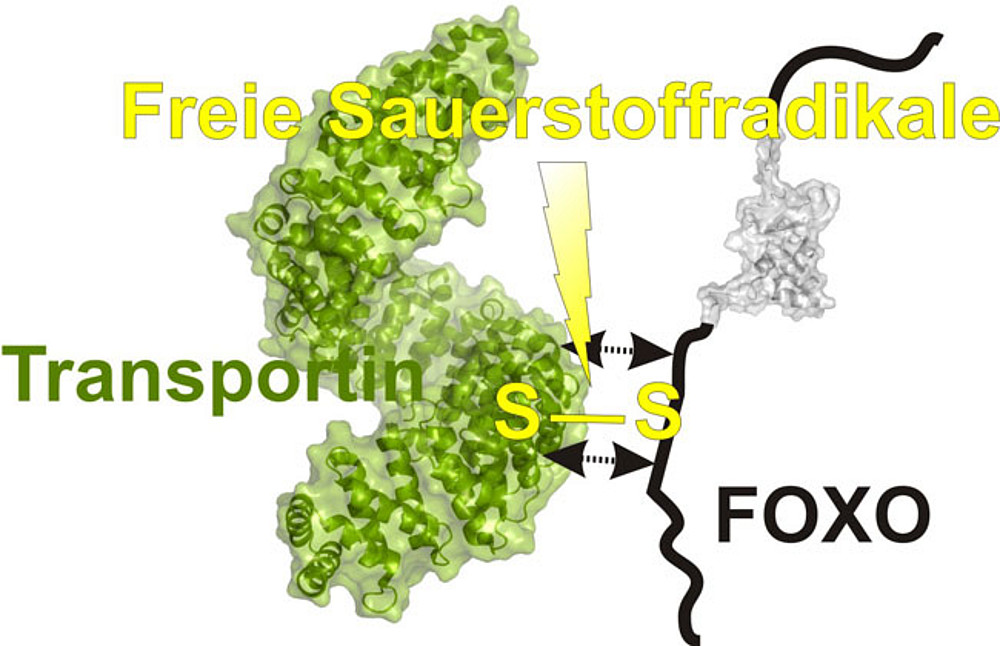
Uni Graz-ForscherInnen erforschen Mechanismen in der Zelle. Foto: Madl.

Uni Graz-ForscherInnen erforschen Mechanismen in der Zelle. Foto: Madl.

ForscherInnen der Uni Graz klären die Funktion von Freien Radikalen im Zellstoffwechsel auf

Freie Sauerstoffradikale sind aggressive Moleküle, die großen Schaden anrichten können, indem sie unkontrolliert chemische Reaktionen eingehen. Sie spielen bei der Alterung und auch bei der Entstehung vieler Krankheiten – wie zum Beispiel Krebs – eine zentrale Rolle. Radikale sind aber auch wichtig für das normale Funktionieren von Zellen im Organismus – sie initiieren ein Signal, das wiederum jene Gene aktiviert, die Zellen vor schädlichen äußeren Einflüssen schützen. Unter der Mitarbeit von Dr. Tobias Madl vom Institut für Chemie der Karl-Franzens-Universität Graz konnte nun ein internationales ForscherInnenteam die molekularen Mechanismen aufklären, die zeigen, wie Radikale die Gene aktivieren. Die Arbeit wurde in der aktuellen Ausgabe der renommierten Fachzeitschrift „Molecular Cell“ publiziert.


Unkontrollierte Zellteilung und Schäden in der Zelle sind die Hauptursachen von Krebs und altersbedingten Krankheiten wie Alzheimer und Parkinson. WissenschafterInnen konnten nun zeigen, dass Sauerstoffradikale eine bestimmte Klasse von Proteinen – sogenannte FOXO Transkriptionsfaktoren – anregen. „Die Proteine sammeln sich im Zellkern an und aktivieren eine Reihe von Genen, die dafür sorgen, dass sich die Zelle nicht mehr teilt und sich somit gegen Schäden schützt“, erklärt Madl. Der von ihm und dem Forschungsteam entdeckte Mechanismus ermöglicht es nun erstmalig, diesen Selbstschutzmechanismus der Zelle zu verstehen. „Mit diesem Wissen können neue Ansätze entwickelt und so eine Reihe von Krebsarten und altersbedingten Krankheiten bekämpft werden“, führt der Chemiker aus.


Der Grazer Tobias Madl forscht an der Universität Graz sowie an der Technischen Universität München und am Helmholtz Zentrum München. Seine Forschungsgruppe arbeitet auf dem Gebiet der Strukturbiologie. Ziel der Vorhaben ist es, die grundlegenden molekularen Mechanismen der Wechselwirkungen unstrukturierter Proteine aufzuklären und damit Einblick in die komplizierte Verbindung zwischen deren Funktion und Krankheiten zu erhalten.


Publikation:
Redox-Dependent Control of FOXO/DAF-16 by Transportin-1,
Putker Marrit, Madl Tobias, Vos Harmjan, de Ruiter Hester, Visscher Marieke, van den Berg MC, Kaplan Mohammed, Korswagen HC, Boelens Rolf, Vermeulen Michiel, Burgering Boudewijn, Dansen Tobias,
Molecular Cell 21. Februar 2013


Online verfügbar unter http://www.cell.com/molecular-cell/abstract/S1097-2765%2812%2901050-7
 

Rückfragen:
Dr. Tobias Madl
Institut für Chemie, Bereich Organische und Bioorganische Chemie
Karl-Franzens-Universität Graz
Tel.: 0316 / 380 – 5340
Mobil: 0699 12182896
E-Mail: tobias.madl(at)uni-graz.at

created by Tobias Madl & Konstantinos Tzivanopoulos

Related news

Learning better: Can science experiments in group settings help children with autism?

How can pupils with autism spectrum disorder (ASD) have positive learning experiences and improve their social skills? Researchers at the University of Graz are investigating how science experiments in group settings can contribute to this. Initial results from the project, which is funded by the Austrian Science Fund FWF, show that children react differently depending on the kind of neurodiversity, but that experimentation classes with the right setting definitely have potential. "Pupils with ASD can do more than is currently expected of them in many cases," says project leader Uwe Simon.

Sustainability Award 2024 for two projects of the University of Graz

How do major international conferences reduce their carbon footprint? And what can maths lessons contribute to education for sustainable development? Two questions that were answered at the University of Graz. The corresponding projects were awarded the Sustainability Award 2024 in silver on 26 November in Vienna. This award for Austria's universities and colleges is presented by the Ministry of Science and the Ministry of Climate Protection.

Bees under observation: University of Graz provides unprecedented insights into the hive

What is going on in the combs? How many eggs is the queen laying? How much honey is there? Autonomous robots and AI algorithms provide important data and high-resolution real-time images from inside a beehive. "As part of an international team, we have developed a game-changer technology for a new type of digitalised behavioural research," reports biologist Thomas Schmickl from the Artifical Life Lab at the University of Graz. The publication, which has just appeared as the cover story in the journal "Science Robotics", describes the wealth of information that can be obtained from this unique research facility.

Research for healthy aging: FWF funds Cluster of Excellence "MetAGE" with 18 million euros

Six researchers from the Field of Excellence "BioHealth" at the University of Graz, together with colleagues from the Medical Universities of Graz and Vienna, have acquired an FWF-funded "Cluster of Excellence". Now a newly formed center of excellence will be created under the leadership of the University of Graz. The aim is to gain a better understanding of healthy aging. The findings will flow directly into clinical research.

Begin of page section:
Additional information:

University of Graz
Universitaetsplatz 3
8010 Graz
Austria
  • Contact
  • Web Editors
  • Moodle
  • UNIGRAZonline
  • Imprint
  • Data Protection Declaration
  • Accessibility Declaration
Weatherstation
Uni Graz

End of this page section. Go to overview of page sections

End of this page section. Go to overview of page sections

Begin of page section:

End of this page section. Go to overview of page sections