Begin of page section:
Page sections:

  • Go to contents (Accesskey 1)
  • Go to position marker (Accesskey 2)
  • Go to main navigation (Accesskey 3)
  • Go to sub navigation (Accesskey 4)
  • Go to additional information (Accesskey 5)
  • Go to page settings (user/language) (Accesskey 8)
  • Go to search (Accesskey 9)

End of this page section. Go to overview of page sections

Begin of page section:
Page settings:

English en
Deutsch de
Search
Login

End of this page section. Go to overview of page sections

Begin of page section:
Search:

Search for details about Uni Graz
Close

End of this page section. Go to overview of page sections


Search

Begin of page section:
Main navigation:

Page navigation:

  • University

    University
    • About the University
    • Organisation
    • Faculties
    • Library
    • Working at University of Graz
    • Campus
    Developing solutions for the world of tomorrow - that is our mission. Our students and our researchers take on the great challenges of society and carry the knowledge out.
  • Research Profile

    Research Profile
    • Our Expertise
    • Research Questions
    • Research Portal
    • Promoting Research
    • Research Transfer
    • Ethics in Research
    • Commission for Scientific Integrity
    Scientific excellence and the courage to break new ground. Research at the University of Graz creates the foundations for making the future worth living.
  • Studies

    Studies
    • Prospective Students
    • Students
  • Community

    Community
    • International
    • Location
    • Research and Business
    • Alumni
    The University of Graz is a hub for international research and brings together scientists and business experts. Moreover, it fosters the exchange and cooperation in study and teaching.
  • Spotlight
Topics
  • Sustainable University
  • Researchers answer
  • Work for us
Close menu

End of this page section. Go to overview of page sections

Begin of page section:
You are here:

University of Graz Natural sciences News Momentaufnahme
  • About the faculty
  • Our research
  • Study Service
  • Dean's office
  • Personalities
  • Institute of Biology

End of this page section. Go to overview of page sections

Monday, 28 October 2013

Momentaufnahme

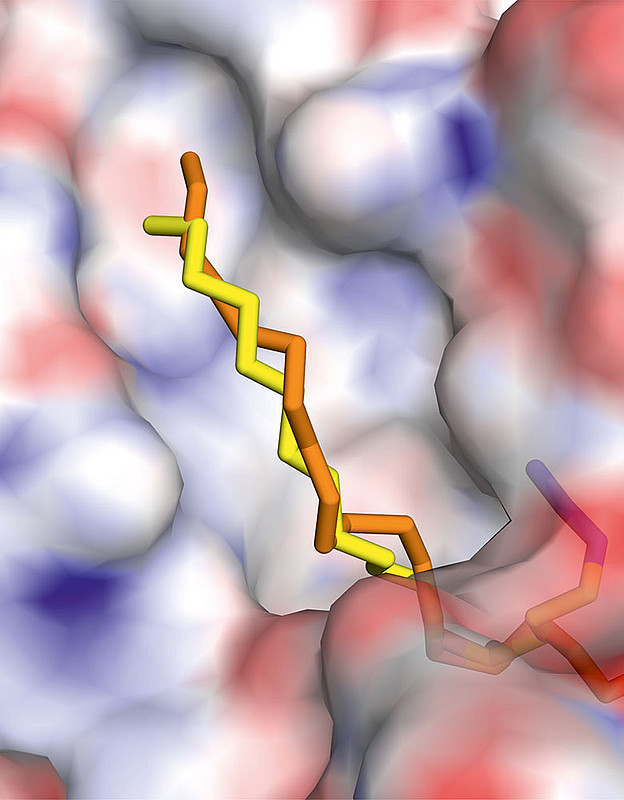
Oberfläche der Monoglyzerid-Lipase (MGL) mit der Monoglyzerid-ähnlichen Substanz in der Bindetasche: Die MGL nimmt den Fettsäurerest des Monoglyzerids in einer Vertiefung auf.

Oberfläche der Monoglyzerid-Lipase (MGL) mit der Monoglyzerid-ähnlichen Substanz in der Bindetasche: Die MGL nimmt den Fettsäurerest des Monoglyzerids in einer Vertiefung auf.

Grazer ForscherInnen konnten erstmals Fettspaltung in flagranti abbilden

Ein wichtiger Schritt in der Erforschung des Fettstoffwechsels ist Grazer ForscherInnen gelungen. Das Team um Ass.-Prof. Dr. Monika Oberer vom Institut für Molekulare Biowissenschaften der Karl-Franzens-Universität Graz konnte erstmals zeigen, wie das Enzym Monoglyzerid-Lipase (MGL) an das Lipid Monoglyzerid bindet, um die Fettspaltung auszulösen. Mittels Röntgenkristallstruktur-Analyse konnten sie den atomaren Aufbau der MGL im Moment des Andockens dreidimensional abbilden. Die Forschungsergebnisse, die kürzlich im renommierten Journal of Biological Chemistry veröffentlicht wurden, tragen dazu bei, Fettstoffwechsel-Störungen oder neurodegenerative Erkrankungen besser zu verstehen und neue Therapiemöglichkeiten zu entwickeln. Die Publikation basiert auf der erfolgreichen Zusammenarbeit von Karl-Franzens-Universität, Medizinischer Universität und TU Graz, unter dem Dach der gemeinsamen Forschungsinitiative BioTechMed-Graz und der Kooperation NAWI Graz. Gefördert wurden die Arbeiten vom Österreichischen Wissenschaftsfonds FWF.


Damit Fett im Körper abgebaut werden kann, sind verschiedene Enzyme nötig. Eines ist die Monoglyzerid-Lipase (MGL). Sie dockt an das Lipid Monogyzerid (MG) an und spaltet es in eine freie Fettsäure und ein kleines Molekül namens Glyzerin auf. Außerdem beeinflusst sie im Gehirn das Schmerzempfinden, und eine gesteigerte MGL-Aktivität spielt bei der Entstehung von Krebs eine Rolle. Damit ist die Erforschung der MGL auch für die Pharmaindustrie von großem Interesse.

2012 hatte Monika Oberer mit ihrer Arbeitsgruppe erstmals die dreidimensionale Kristallstruktur der MGL publiziert. Was die ForscherInnen damals noch nicht wussten: Wie bindet die MGL an das Monoglyzerid, um die Fettspaltung auszulösen und welche Aminosäuren sind an diesem Vorgang beteiligt? Diese Fragen konnten nun geklärt werden.


Schlüssel und Schloss

„Da die Fettspaltung im Moment des Andockens passiert und sich dieser Augenblick nicht festhalten lässt, verwendeten wir für unsere Untersuchungen eine Monoglyzerid-ähnliche Substanz, die an die MGL bindet, aber nicht gespalten werden kann“, erklärt Monika Oberer. Hergestellt wurde diese Substanz von Teams um Assoz. Prof. Dr. Ruth Birner-Grünberger von der Med Uni Graz und Univ.-Prof. Dr. Rolf Breinbauer von der TU Graz. So konnten die ForscherInnen den Moment des Andockens gewissermaßen „einfrieren“, die Bindung mittels Röntgenkristallstrukturanalyse untersuchen und dreidimensional abbilden.

„Dort, wo das Monoglyzerid andockt, weist die MGL eine Vertiefung auf, in die sie das Monoglyzerid aufnimmt, wie ein Schloss den Schlüssel“, fasst Monika Oberer zusammen. Dabei entdeckten die WissenschafterInnen ein weiteres interessantes Detail: „Wir haben in der Bindungsregion der MGL sowohl offene als auch geschlossene Strukturen gesehen und herausgefunden, dass für diese Strukturveränderungen die Aminosäure Isoleucin verantwortlich ist“, berichtet die Forscherin. Ist die Struktur geschlossen, bietet sie genau nur einem Fettsäurerest Platz.

„Das ist mit hoher Wahrscheinlichkeit auch die Erklärung dafür, warum ausschließlich Monoglyzeride – sie haben nur einen Fettsäurerest – an die MGL binden“, freut sich Monika Oberer, noch eine bis dato offene Frage beantworten zu können.

Als Modellsystem für ihre Forschungen dienten den StrukturbiologInnen der Uni Graz Bakterien. Wie frühere Untersuchungen gezeigt haben, weisen die bakterielle und die humane MGL hohe strukturelle Ähnlichkeiten auf, so dass die gewonnenen Erkenntnisse auch die Wirkungsweise der Monoglyzerid-Lipase beim Menschen erklären können.


Publikation:

Srinivasan Rengachari, Philipp Aschauer, Matthias Schittmayer, Nicole Mayer, Karl Gruber, Rolf Breinbauer, Ruth Birner-Gruenberger, Ingrid Dreveny and Monika Oberer:

Conformational plasticity and ligand binding of bacterial monoacylglycerol lipase

The Journal of Biological Chemistry, Vol. 288, Issue 43, 31093-31104, October 25, 2013

created by Gudrun Pichler

Related news

Learning better: Can science experiments in group settings help children with autism?

How can pupils with autism spectrum disorder (ASD) have positive learning experiences and improve their social skills? Researchers at the University of Graz are investigating how science experiments in group settings can contribute to this. Initial results from the project, which is funded by the Austrian Science Fund FWF, show that children react differently depending on the kind of neurodiversity, but that experimentation classes with the right setting definitely have potential. "Pupils with ASD can do more than is currently expected of them in many cases," says project leader Uwe Simon.

Sustainability Award 2024 for two projects of the University of Graz

How do major international conferences reduce their carbon footprint? And what can maths lessons contribute to education for sustainable development? Two questions that were answered at the University of Graz. The corresponding projects were awarded the Sustainability Award 2024 in silver on 26 November in Vienna. This award for Austria's universities and colleges is presented by the Ministry of Science and the Ministry of Climate Protection.

Bees under observation: University of Graz provides unprecedented insights into the hive

What is going on in the combs? How many eggs is the queen laying? How much honey is there? Autonomous robots and AI algorithms provide important data and high-resolution real-time images from inside a beehive. "As part of an international team, we have developed a game-changer technology for a new type of digitalised behavioural research," reports biologist Thomas Schmickl from the Artifical Life Lab at the University of Graz. The publication, which has just appeared as the cover story in the journal "Science Robotics", describes the wealth of information that can be obtained from this unique research facility.

Research for healthy aging: FWF funds Cluster of Excellence "MetAGE" with 18 million euros

Six researchers from the Field of Excellence "BioHealth" at the University of Graz, together with colleagues from the Medical Universities of Graz and Vienna, have acquired an FWF-funded "Cluster of Excellence". Now a newly formed center of excellence will be created under the leadership of the University of Graz. The aim is to gain a better understanding of healthy aging. The findings will flow directly into clinical research.

Begin of page section:
Additional information:

University of Graz
Universitaetsplatz 3
8010 Graz
Austria
  • Contact
  • Web Editors
  • Moodle
  • UNIGRAZonline
  • Imprint
  • Data Protection Declaration
  • Accessibility Declaration
Weatherstation
Uni Graz

End of this page section. Go to overview of page sections

End of this page section. Go to overview of page sections

Begin of page section:

End of this page section. Go to overview of page sections