Begin of page section:
Page sections:

  • Go to contents (Accesskey 1)
  • Go to position marker (Accesskey 2)
  • Go to main navigation (Accesskey 3)
  • Go to sub navigation (Accesskey 4)
  • Go to additional information (Accesskey 5)
  • Go to page settings (user/language) (Accesskey 8)
  • Go to search (Accesskey 9)

End of this page section. Go to overview of page sections

Begin of page section:
Page settings:

English en
Deutsch de
Search
Login

End of this page section. Go to overview of page sections

Begin of page section:
Search:

Search for details about Uni Graz
Close

End of this page section. Go to overview of page sections


Search

Begin of page section:
Main navigation:

Page navigation:

  • University

    University
    • About the University
    • Organisation
    • Faculties
    • Library
    • Working at University of Graz
    • Campus
    Developing solutions for the world of tomorrow - that is our mission. Our students and our researchers take on the great challenges of society and carry the knowledge out.
  • Research Profile

    Research Profile
    • Our Expertise
    • Research Questions
    • Research Portal
    • Promoting Research
    • Research Transfer
    • Ethics in Research
    • Commission for Scientific Integrity
    Scientific excellence and the courage to break new ground. Research at the University of Graz creates the foundations for making the future worth living.
  • Studies

    Studies
    • Prospective Students
    • Students
  • Community

    Community
    • International
    • Location
    • Research and Business
    • Alumni
    The University of Graz is a hub for international research and brings together scientists and business experts. Moreover, it fosters the exchange and cooperation in study and teaching.
  • Spotlight
Topics
  • Sustainable University
  • Researchers answer
  • Work for us
Close menu

End of this page section. Go to overview of page sections

Begin of page section:
You are here:

University of Graz Natural sciences News Rettung aus dem Darm
  • About the faculty
  • Our research
  • Study Service
  • Dean's office
  • Personalities
  • Institute of Biology

End of this page section. Go to overview of page sections

Thursday, 06 June 2013

Rettung aus dem Darm
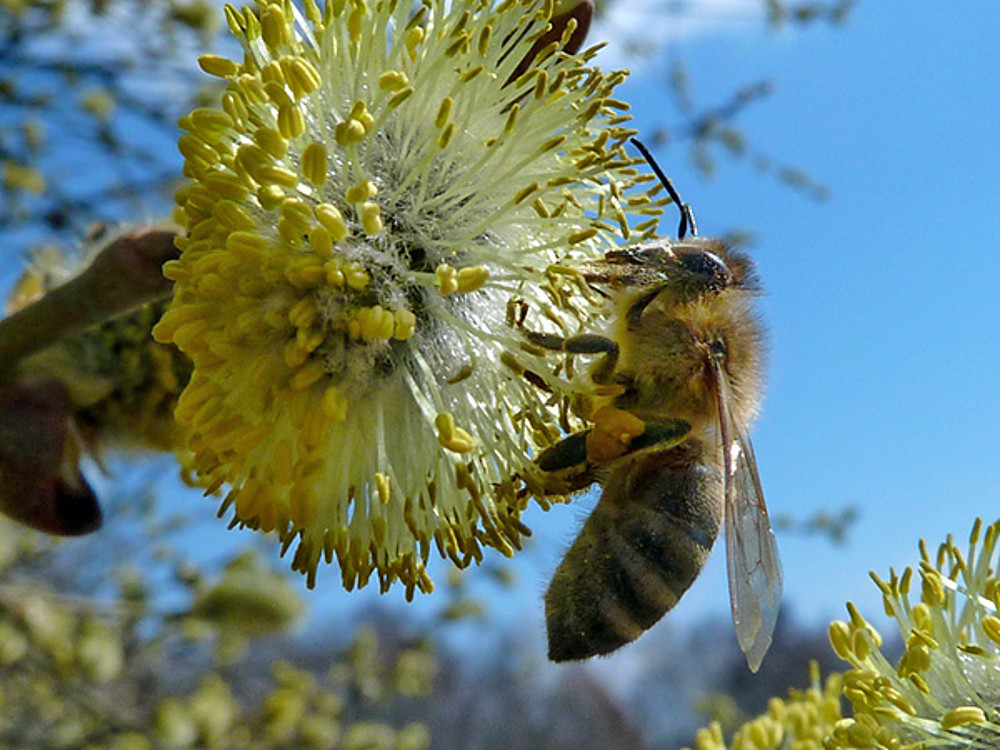
Die Bienenkrankheit "Amerikanische Faulbrut" rafft oft ganze Völker dahin. ForscherInnen der Uni Graz haben nun ein Mittel dagegen zum Patent angemeldet.

Die Bienenkrankheit "Amerikanische Faulbrut" rafft oft ganze Völker dahin. ForscherInnen der Uni Graz haben nun ein Mittel dagegen zum Patent angemeldet. Foto: pixelio.de

Uni Graz meldet Mittel gegen Bienenkrankheit zum Patent an

Nicht nur Pestizide machen Bienen zu schaffen, auch verschiedene Krankheiten raffen mitunter ganze Völker dahin. Gegen eine der tödlichsten – die Amerikanische Faulbrut – haben ZoologInnen der Karl-Franzens-Universität Graz nun ein höchst wirksames Mittel gefunden und zum Patent angemeldet.
„Die Amerikanische Faulbrut wird durch ein sporenbildendes Bakterium übertragen und befällt nur die junge Brut während der ersten Lebenstage“, erklärt Dr. Ulrike Riessberger-Gallé vom Institut für Zoologie der Uni Graz. Ammenbienen füttern die jungen Larven und stecken sie so mit Bakteriensporen an. Ältere Larven und erwachsene Bienen sind gegen die Krankheit unempfindlich.
Im Zuge ihrer Forschungsarbeiten stellte Riessberger-Gallé fest, dass die Bienen eine Substanz im Darm haben, die sie vor der Faulbrut schützt. In einem vom Österreichischen Wissenschaftsfonds FWF geförderten Projekt gelang es, diese zu isolieren und zu beschreiben. Konkret handelt es sich um das so genannte Lyso-Phosphatidylcholin, kurz LPC, das im Reagenzglas das Wachstum der Faulbrut-Erreger unterdrückt.
„Wir haben in unserem Labor eine Methode der künstlichen Larvenzucht weiterentwickelt, die für unsere Forschungen zur Bienengesundheit enorm hilfreich ist“, teilt die Zoologin mit. Die Larven wurden mit LPC gefüttert und haben das selbst in hohen Dosen gut vertragen. Da der Einsatz von Antibiotika zur Bekämpfung der Faulbrut in Österreich verboten ist, müssen derzeit befallene Stöcke vernichtet werden. „Jetzt haben wir äußerst wirksames Mittel gefunden und suchen ParnterInnen aus der Wirtschaft, die dieses auch auf den Markt bringen“, freut sich Riessberger-Gallé. Die Substanz wurde europaweit zum Patent angemeldet. Das Team der Uni Graz forscht nun weiter an Methoden, wie LPC den Larven – die nur fressen, was sie von den Ammenbienen gefüttert bekommen – am besten verabreicht werden kann. „Man könnte beispielsweise ganze Waben, in denen sich Larven befinden, besprühen, in eine Lösung tauchen oder die Substanz ins Wachs eingießen“, führt die Wissenschafterin aus.
An dem Projekt sind auch der Chemiker Wolfgang Schühly, der Dissertant Javier Hernandez-Lopez sowie Institutsleiter Karl Crailsheim maßgeblich beteiligt.

created by Dagmar Eklaude

Related news

Learning better: Can science experiments in group settings help children with autism?

How can pupils with autism spectrum disorder (ASD) have positive learning experiences and improve their social skills? Researchers at the University of Graz are investigating how science experiments in group settings can contribute to this. Initial results from the project, which is funded by the Austrian Science Fund FWF, show that children react differently depending on the kind of neurodiversity, but that experimentation classes with the right setting definitely have potential. "Pupils with ASD can do more than is currently expected of them in many cases," says project leader Uwe Simon.

Sustainability Award 2024 for two projects of the University of Graz

How do major international conferences reduce their carbon footprint? And what can maths lessons contribute to education for sustainable development? Two questions that were answered at the University of Graz. The corresponding projects were awarded the Sustainability Award 2024 in silver on 26 November in Vienna. This award for Austria's universities and colleges is presented by the Ministry of Science and the Ministry of Climate Protection.

Bees under observation: University of Graz provides unprecedented insights into the hive

What is going on in the combs? How many eggs is the queen laying? How much honey is there? Autonomous robots and AI algorithms provide important data and high-resolution real-time images from inside a beehive. "As part of an international team, we have developed a game-changer technology for a new type of digitalised behavioural research," reports biologist Thomas Schmickl from the Artifical Life Lab at the University of Graz. The publication, which has just appeared as the cover story in the journal "Science Robotics", describes the wealth of information that can be obtained from this unique research facility.

Research for healthy aging: FWF funds Cluster of Excellence "MetAGE" with 18 million euros

Six researchers from the Field of Excellence "BioHealth" at the University of Graz, together with colleagues from the Medical Universities of Graz and Vienna, have acquired an FWF-funded "Cluster of Excellence". Now a newly formed center of excellence will be created under the leadership of the University of Graz. The aim is to gain a better understanding of healthy aging. The findings will flow directly into clinical research.

Begin of page section:
Additional information:

University of Graz
Universitaetsplatz 3
8010 Graz
Austria
  • Contact
  • Web Editors
  • Moodle
  • UNIGRAZonline
  • Imprint
  • Data Protection Declaration
  • Accessibility Declaration
Weatherstation
Uni Graz

End of this page section. Go to overview of page sections

End of this page section. Go to overview of page sections

Begin of page section:

End of this page section. Go to overview of page sections