Begin of page section:
Page sections:

  • Go to contents (Accesskey 1)
  • Go to position marker (Accesskey 2)
  • Go to main navigation (Accesskey 3)
  • Go to sub navigation (Accesskey 4)
  • Go to additional information (Accesskey 5)
  • Go to page settings (user/language) (Accesskey 8)
  • Go to search (Accesskey 9)

End of this page section. Go to overview of page sections

Begin of page section:
Page settings:

English en
Deutsch de
Search
Login

End of this page section. Go to overview of page sections

Begin of page section:
Search:

Search for details about Uni Graz
Close

End of this page section. Go to overview of page sections


Search

Begin of page section:
Main navigation:

Page navigation:

  • University

    University
    • About the University
    • Organisation
    • Faculties
    • Library
    • Working at University of Graz
    • Campus
    Developing solutions for the world of tomorrow - that is our mission. Our students and our researchers take on the great challenges of society and carry the knowledge out.
  • Research Profile

    Research Profile
    • Our Expertise
    • Research Questions
    • Research Portal
    • Promoting Research
    • Research Transfer
    • Ethics in Research
    • Commission for Scientific Integrity
    Scientific excellence and the courage to break new ground. Research at the University of Graz creates the foundations for making the future worth living.
  • Studies

    Studies
    • Prospective Students
    • Students
  • Community

    Community
    • International
    • Location
    • Research and Business
    • Alumni
    The University of Graz is a hub for international research and brings together scientists and business experts. Moreover, it fosters the exchange and cooperation in study and teaching.
  • Spotlight
Topics
  • Sustainable University
  • Researchers answer
  • Work for us
Close menu

End of this page section. Go to overview of page sections

Begin of page section:
You are here:

University of Graz Natural sciences News Schräge Vögel
  • About the faculty
  • Our research
  • Study Service
  • Dean's office
  • Personalities
  • Institute of Biology

End of this page section. Go to overview of page sections

Monday, 16 November 2015

Schräge Vögel

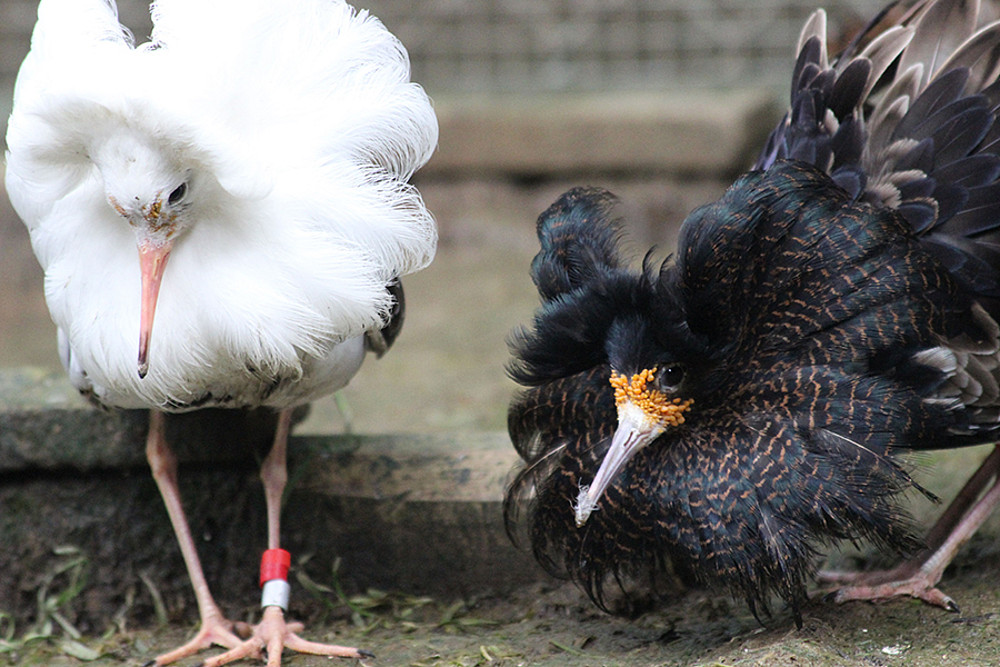
Balzende Kampfläufer-Männchen: Satellit (links) und unabhängiger Kämpfer Foto: Clemens Küpper

Balzende Kampfläufer-Männchen: Satellit (links) und unabhängiger Kämpfer Foto: Clemens Küpper

Kampfläufer-Männchen mit Gendefekt und ohne Aggression bei den Weibchen erfolgreich

Aggressives Verhalten ist genetisch beeinflusst und für die Fortpflanzung bedeutend. Ein internationales ForscherInnen-Team mit starker Beteiligung der Uni Graz hat nun bei der Vogelart der Kampfläufer herausgefunden, welche Veränderung des Erbguts dazu führt, dass auch Vögel ohne Angriffslust bei den Weibchen punkten können. Die Forschungsarbeit erscheint heute, den 16. November 2015 in der renommierten Fachzeitschrift Nature Genetics.

Wie die Gladiatoren in einer Arena versammeln sich die männlichen Kampfläufer im prächtigen Federkleid bei der Balz und rittern jedes Frühjahr um die Gunst der Weibchen. Dabei ist der Name des vor allem in der Tundra beheimateten Vogels auch Programm. Jene, die besonders dominant und aggressiv auftreten, werden von den Weibchen bevorzugt. Doch es geht auch anders, wie Dr. Clemens Küpper vom Institut für Zoologie der Uni Graz erklärt. „Es gibt drei unterschiedliche Typen der Kampfläufer. Im Unterschied zum angriffslustigen Kämpfer-Typ verfolgen zwei andere, die sogenannten Satelliten- und Faeder-Männchen, erfolgreiche Paarungsstrategien ganz ohne Aggression“, erläutert Küpper.

Satelliten zeichnen sich durch auffallend helles Gefieder aus. Faeder wiederum geben sich als Weibchen aus, um von den aggressiven Kämpfern geduldet zu werden. Beide Typen nutzen die Konfusion in den Balzarenen, die bei den häufigen Kämpfen vorherrscht, um sich mit Weibchen zu paaren. „Die Grundlagen für diese drei Formen ist Kampfläufern in ihrer Erbinformation festgeschrieben“, begründet der Forscher und Erstautor der aktuellen Publikation in Nature Genetics.

Als Teil eines internationalen Teams, darunter ForscherInnen der Universitäten Graz, Sheffield und Edinburgh (Großbritannien) sowie der Simon Fraser University in Burnaby (Kanada), hat der Evolutionsbiologe die genetischen Unterschiede zwischen den drei Formen genau unter die Lupe genommen. Küpper und seine KollegInnen konnten eruieren, welcher Abschnitt der DNA für dieses atypische, sanfte Verhalten verantwortlich ist: „Den Unterschieden des Satelliten- und des Faeder-Männchens liegt eine Inversion, das ist eine seltene Umstrukturierung eines Chromosomenabschnitts, zugrunde. Die ursprüngliche, bereits Millionen Jahre alte Veränderung ist durch einen Gen-Defekt in einigen Fällen sogar tödlich. Allerdings scheinen andere Qualitäten der Faeder- und Satelliten-Männchen dieses Manko zu kompensieren. Der von der Inversion betroffene Abschnitt enthält mehrere vielversprechende Kandidaten-Gene für Aggressionsverhalten, die Küpper in Zukunft erforschen will.


Ruff males with genetic handicap pull females without being rough

Aggressive behaviour is genetically determined and important for reproductive success. An international research team including researchers from the Universities of Sheffield and Edinburgh (UK), Simon Fraser University Burnaby, Canada, and the University of Graz, Austria has now described the genetic changes required that in the ruff, a peculiar wading bird, some males can hit it off with females without fighting other males. The research is published today in the journal Nature Genetics.

Like ancient gladiators, ruff males in elaborated plumage meet in mating arenas every spring to fight vigorously their competitors over females. The most successful fighters are rewarded with the hearts of most of the visiting ladies. However, certain males use other strategies to entice the females, explains Clemens Küpper, an author of the study, who works at the Institute of Zoology at the University of Graz. “There are three kinds of ruffs. Most ruffs use an aggressive so-called ‘independent’ strategy to get the best territory and the attention of the females. However, Satellite and Faeder males are competitive without having to fight other males”, Küpper says.
Satellites are characterised by conspicuous light breeding plumage, whereas Faeder males ‘cross-dress’ as females to avoid being hassled by aggressive ruffs. The two alternative male types use the confusion that frequently arises during the fights among Independents in the mating arenas to rapidly mate with present females.

“The strategy that each ruff adopts is determined by its genes”, Küpper states. Funded by a Marie Curie European Fellowship and a grant of the Biotechnology and Biological Sciences Research Council, Küpper and his colleagues analysed genome sequences of Faeder, Satellite and Independent males. They found that an inversion, a rare aberration at one of the chromosomes, is the basis for the behavioural differences between ruff males: “The initial genetic change destroyed one of the genes and can be lethal.” Satellite and Faeder males, however, seem to have evolved other qualities to compensate for this handicap. The inverted part of the chromosome contains several candidate genes for aggressive behaviour, which Küpper plans to study in more detail in the future.

created by Andreas Schweiger

Related news

Learning better: Can science experiments in group settings help children with autism?

How can pupils with autism spectrum disorder (ASD) have positive learning experiences and improve their social skills? Researchers at the University of Graz are investigating how science experiments in group settings can contribute to this. Initial results from the project, which is funded by the Austrian Science Fund FWF, show that children react differently depending on the kind of neurodiversity, but that experimentation classes with the right setting definitely have potential. "Pupils with ASD can do more than is currently expected of them in many cases," says project leader Uwe Simon.

Sustainability Award 2024 for two projects of the University of Graz

How do major international conferences reduce their carbon footprint? And what can maths lessons contribute to education for sustainable development? Two questions that were answered at the University of Graz. The corresponding projects were awarded the Sustainability Award 2024 in silver on 26 November in Vienna. This award for Austria's universities and colleges is presented by the Ministry of Science and the Ministry of Climate Protection.

Bees under observation: University of Graz provides unprecedented insights into the hive

What is going on in the combs? How many eggs is the queen laying? How much honey is there? Autonomous robots and AI algorithms provide important data and high-resolution real-time images from inside a beehive. "As part of an international team, we have developed a game-changer technology for a new type of digitalised behavioural research," reports biologist Thomas Schmickl from the Artifical Life Lab at the University of Graz. The publication, which has just appeared as the cover story in the journal "Science Robotics", describes the wealth of information that can be obtained from this unique research facility.

Research for healthy aging: FWF funds Cluster of Excellence "MetAGE" with 18 million euros

Six researchers from the Field of Excellence "BioHealth" at the University of Graz, together with colleagues from the Medical Universities of Graz and Vienna, have acquired an FWF-funded "Cluster of Excellence". Now a newly formed center of excellence will be created under the leadership of the University of Graz. The aim is to gain a better understanding of healthy aging. The findings will flow directly into clinical research.

Begin of page section:
Additional information:

University of Graz
Universitaetsplatz 3
8010 Graz
Austria
  • Contact
  • Web Editors
  • Moodle
  • UNIGRAZonline
  • Imprint
  • Data Protection Declaration
  • Accessibility Declaration
Weatherstation
Uni Graz

End of this page section. Go to overview of page sections

End of this page section. Go to overview of page sections

Begin of page section:

End of this page section. Go to overview of page sections