Begin of page section:
Page sections:

  • Go to contents (Accesskey 1)
  • Go to position marker (Accesskey 2)
  • Go to main navigation (Accesskey 3)
  • Go to sub navigation (Accesskey 4)
  • Go to additional information (Accesskey 5)
  • Go to page settings (user/language) (Accesskey 8)
  • Go to search (Accesskey 9)

End of this page section. Go to overview of page sections

Begin of page section:
Page settings:

English en
Deutsch de
Search
Login

End of this page section. Go to overview of page sections

Begin of page section:
Search:

Search for details about Uni Graz
Close

End of this page section. Go to overview of page sections


Search

Begin of page section:
Main navigation:

Page navigation:

  • University

    University
    • About the University
    • Organisation
    • Faculties
    • Library
    • Working at University of Graz
    • Campus
    Developing solutions for the world of tomorrow - that is our mission. Our students and our researchers take on the great challenges of society and carry the knowledge out.
  • Research Profile

    Research Profile
    • Our Expertise
    • Research Questions
    • Research Portal
    • Promoting Research
    • Research Transfer
    • Ethics in Research
    • Commission for Scientific Integrity
    Scientific excellence and the courage to break new ground. Research at the University of Graz creates the foundations for making the future worth living.
  • Studies

    Studies
    • Prospective Students
    • Students
    • Welcome Weeks for First Year Students
  • Community

    Community
    • International
    • Location
    • Research and Business
    • Alumni
    The University of Graz is a hub for international research and brings together scientists and business experts. Moreover, it fosters the exchange and cooperation in study and teaching.
Topics
  • Sustainable University
  • Researchers answer
  • Work for us
Close menu

End of this page section. Go to overview of page sections

Begin of page section:
You are here:

University of Graz Natural sciences News Elektrisierend: Forschende filmen die ersten Augenblicke auf dem Weg von Licht zu Strom
  • About the faculty
  • Our research
  • Study Service
  • Dean's office
  • Personalities

End of this page section. Go to overview of page sections

Tuesday, 01 September 2026

Electrifying: Researchers film the first moments on the way from light to electricity

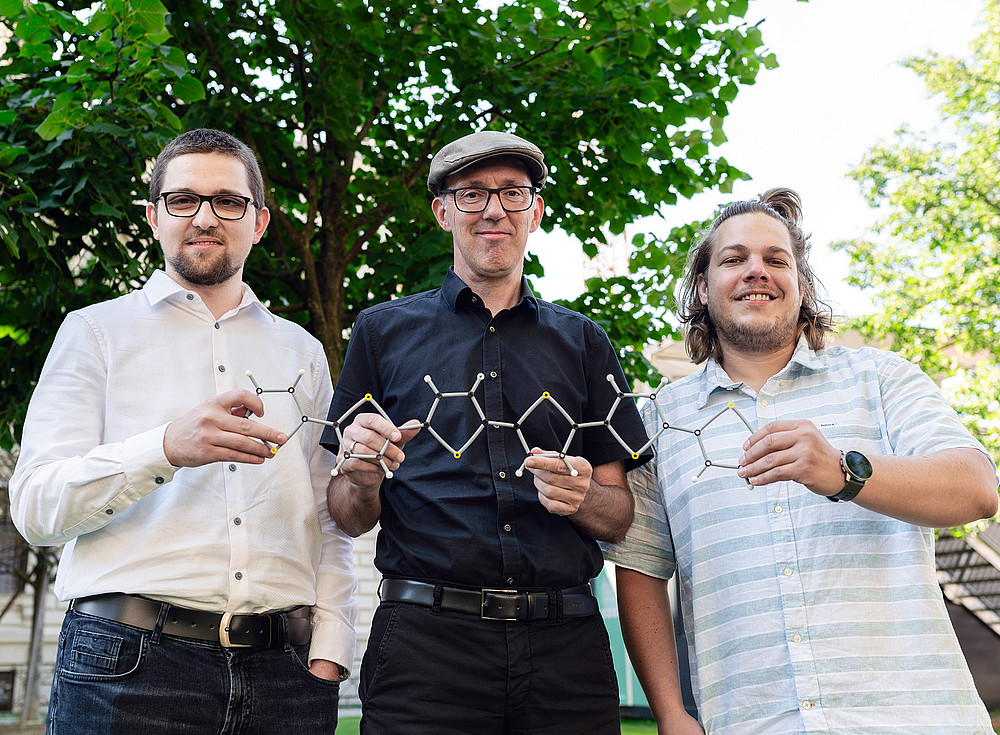
Three men of different ages, two wearing glasses, two in light-coloured shirts and one in a dark shirt, are standing outdoors in front of some trees, holding a chemical structure model between them. ©Uni Graz/Angele
©Uni Graz/Angele

Peter Puschnig (centre) with PhD student Siegfried Kaidisch (left) and postdoctoral researcher Christian Kern from his research group at the University of Graz

Physicists at the University of Graz (Austria), in collaboration with colleagues from Marburg University and Forschungszentrum Jülich (Germany), have achieved a scientific breakthrough. For the first time, the generation of electrical energy from light has been filmed and described theoretically. This work is of far-reaching significance, not least for optimising sustainable energy production from photovoltaics. This is because it provides fundamental building blocks for understanding the physical processes that take place, for example, in organic solar cells. The paper was published in the journal Physical Review X, one of the world’s most prestigious physics journals.


Whether in solar cells or during photosynthesis – when light strikes a surface, its particles, the photons, are absorbed by the material and thereby energise electrons. In the process, their spatial distribution – the so-called wave function – changes, and a bond is formed between an electron and the resulting electron hole. These ‘excited pairs’ are known as excitons. They play a key role in modern optoelectronic materials. However, although they have been known for decades, their internal quantum-mechanical structure has remained largely hidden until now. “We have now succeeded for the first time in experimentally reconstructing the spatial distribution and temporal evolution of an exciton’s wave function in the very first moments of its existence,” reports Peter Puschnig, Professor of Electronic Structure of Nanomaterials at the Department of Physics, University of Graz. “The measurements show that, after its formation, the electron-hole pair extends across approximately three molecules and then shrinks by around 25 per cent within the first 400 femtoseconds – a quadrillionth of a second,” explains the researcher. 

To film this process, the scientists first excited the exciton with an ultrashort light pulse and then ejected the electrons from the pair bond using a second high-energy laser pulse. The latter process is as known photoemission. “If we then measure the energy and direction of the electrons, theoretical models allow us to infer their quantum-mechanical state. By varying the time delay between the excitation and the subsequent laser pulse, one obtains different snapshots of the exciton, which can be pieced together to form a video of the quantum world,” explains Puschnig.

Leading international research
The work was carried out in close collaboration between three leading international research groups. Stefan Tautz and his team at Forschungszentrum Jülich produced the organic semiconductor samples, characterised them and transported them to Marburg under ultra-high vacuum conditions, ensuring that their exceptional quality was maintained right up to the measurement. “The samples consist of wafer-thin, ordered films of the rod-shaped 6T molecule that have been deposited onto a specially prepared copper surface. The precise alignment of the molecules and their targeted decoupling from the substrate are important for maintaining the exciton long enough to make its formation visible,” explains Monja Stettner, who prepared the samples as part of her dissertation and assisted with the experiments in Marburg. The group led by Ulrich Höfer at Marburg University carried out the high-precision photoemission experiments and analysed the measurement data. 

At the University of Graz, Peter Puschnig’s team developed the theoretical concepts for describing photoemission from excitons, carried out the quantum mechanical simulations and developed an analytical model that enabled the interpretation of the experimental data. “Using our model, it is possible to deduce the spatial shape and the internal quantum-mechanical phase of the exciton wave function directly from measured photoelectron images,” explains Siegfried Kaidisch, who made a key contribution to this work as part of his PhD thesis. The experimental method underlying the research – Photoemission Orbital Tomography (POT) – was also developed in Peter Puschnig’s group and has, in recent years, been expanded in collaboration with Stefan Tautz’s team at Forschungszentrum Jülich into an internationally established tool for investigating electronic states in organic materials.

EU research project
The current publication marks one of the most significant milestones to date in the EU project ‘Orbital Cinema’. Funded by an ERC Synergy Grant, the research project aims to visualise the dynamics of electrons in materials with unprecedented spatial and temporal resolution. “In the next step, we want to observe the separation of electrons and holes in so-called donor-acceptor systems. This process determines how efficiently light can be converted into electrical current and is therefore central to future developments in organic photovoltaics,” says Puschnig.

Publication
Observing the spatial and temporal evolution of exciton wave functions in organic semiconductors
Marcel Theilen, Siegfried Kaidisch, Monja Stettner, Sarah Zajusch, Eric Fackelman, Alexa Adamkiewicz, Robert Wallauer, Andreas Windischbacher, Christian S. Kern, Michael G. Ramsey, François C. Bocquet, Serguei Soubatch, F. Stefan Tautz, Ulrich Höfer, and Peter Puschnig
Physical Review X, 28 August 2026
https://doi.org/10.1103/3zmg-276c

Video: The evolution of an exciton
The animation is based on data calculated using the model developed by Peter Puschnig’s research group at the University of Graz. It shows an amplified version of what was measured in the experiment, in order to make the processes more clearly visible. In principle, however, the wave function (right) can be inferred from experimental photoemission data (left). © Siegfried Kaidisch, University of Graz


If you are interested in the quantum world, you can study physics at the University of Graz.
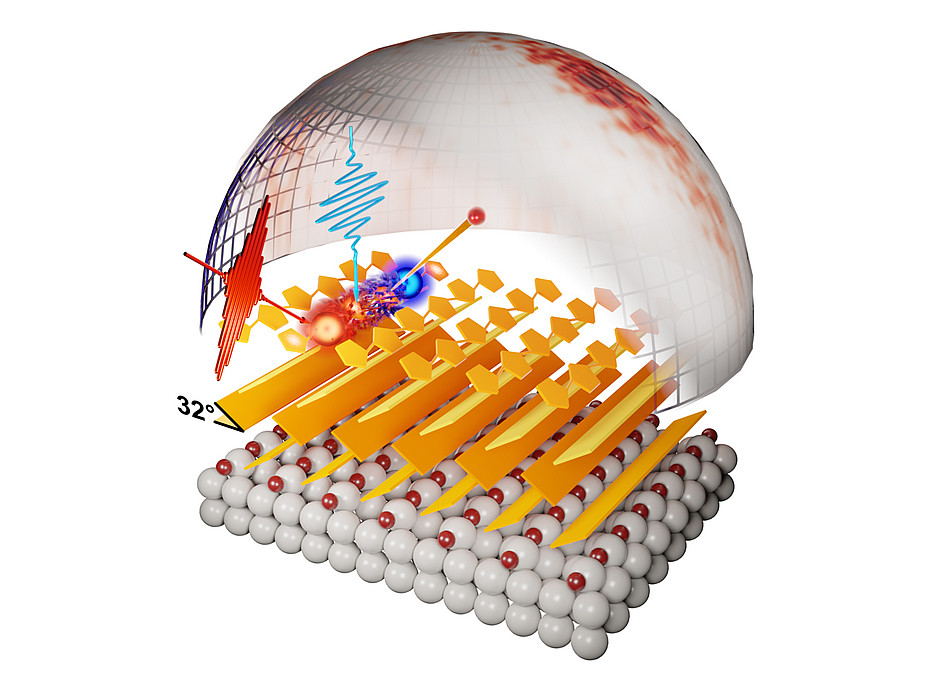
Schematic representation of excitons on a crystal surface, showing yellow arrows, light waves and an angle of 32° ©Andreas Windischbacher, University of Graz
©Andreas Windischbacher, University of Graz
In time-resolved Photoemission Orbital Tomography, a pump laser pulse (blue) generates a bound electron-hole pair (exciton) in the organic semiconductor material alpha-sexithiophene. The subsequent high-energy UV laser pulse ejects an electron from the exciton, and the energy and direction of this electron are measured.
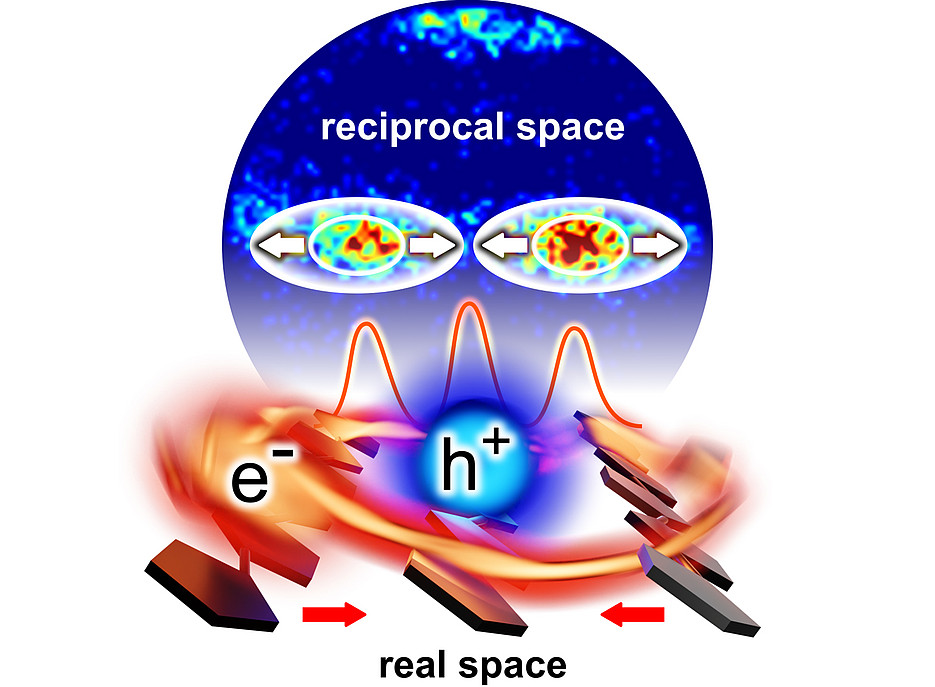
Visualisation of an electron (e⁻) and a hole (h⁺) and the exciton wave function, using arrows, a wave and coloured bands ©Andreas Windischbacher, University of Graz
©Andreas Windischbacher, University of Graz
The measured energy and angular distributions of the emitted electrons allow the exciton wave functions to be reconstructed. It is observed that the size of the exciton shrinks by 25 per cent over the first 400 femtoseconds, from an initial value of approximately 1.5 nanometres.
created by Gudrun Pichler

Related news

Learning better: Can science experiments in group settings help children with autism?

How can pupils with autism spectrum disorder (ASD) have positive learning experiences and improve their social skills? Researchers at the University of Graz are investigating how science experiments in group settings can contribute to this. Initial results from the project, which is funded by the Austrian Science Fund FWF, show that children react differently depending on the kind of neurodiversity, but that experimentation classes with the right setting definitely have potential. "Pupils with ASD can do more than is currently expected of them in many cases," says project leader Uwe Simon.

Sustainability Award 2024 for two projects of the University of Graz

How do major international conferences reduce their carbon footprint? And what can maths lessons contribute to education for sustainable development? Two questions that were answered at the University of Graz. The corresponding projects were awarded the Sustainability Award 2024 in silver on 26 November in Vienna. This award for Austria's universities and colleges is presented by the Ministry of Science and the Ministry of Climate Protection.

Bees under observation: University of Graz provides unprecedented insights into the hive

What is going on in the combs? How many eggs is the queen laying? How much honey is there? Autonomous robots and AI algorithms provide important data and high-resolution real-time images from inside a beehive. "As part of an international team, we have developed a game-changer technology for a new type of digitalised behavioural research," reports biologist Thomas Schmickl from the Artifical Life Lab at the University of Graz. The publication, which has just appeared as the cover story in the journal "Science Robotics", describes the wealth of information that can be obtained from this unique research facility.

Research for healthy aging: FWF funds Cluster of Excellence "MetAGE" with 18 million euros

Six researchers from the Field of Excellence "BioHealth" at the University of Graz, together with colleagues from the Medical Universities of Graz and Vienna, have acquired an FWF-funded "Cluster of Excellence". Now a newly formed center of excellence will be created under the leadership of the University of Graz. The aim is to gain a better understanding of healthy aging. The findings will flow directly into clinical research.

Begin of page section:
Additional information:

University of Graz
Universitaetsplatz 3
8010 Graz
Austria
  • Contact
  • Web Editors
  • Moodle
  • UNIGRAZonline
  • Imprint
  • Data Protection Declaration
  • Accessibility Declaration
Weatherstation
Uni Graz

End of this page section. Go to overview of page sections

End of this page section. Go to overview of page sections

Begin of page section:

End of this page section. Go to overview of page sections