Begin of page section:
Page sections:

  • Go to contents (Accesskey 1)
  • Go to position marker (Accesskey 2)
  • Go to main navigation (Accesskey 3)
  • Go to sub navigation (Accesskey 4)
  • Go to additional information (Accesskey 5)
  • Go to page settings (user/language) (Accesskey 8)
  • Go to search (Accesskey 9)

End of this page section. Go to overview of page sections

Begin of page section:
Page settings:

English en
Deutsch de
Search
Login

End of this page section. Go to overview of page sections

Begin of page section:
Search:

Search for details about Uni Graz
Close

End of this page section. Go to overview of page sections


Search

Begin of page section:
Main navigation:

Page navigation:

  • University

    University
    • About the University
    • Organisation
    • Faculties
    • Library
    • Working at University of Graz
    • Campus
    Developing solutions for the world of tomorrow - that is our mission. Our students and our researchers take on the great challenges of society and carry the knowledge out.
  • Research Profile

    Research Profile
    • Our Expertise
    • Research Questions
    • Research Portal
    • Promoting Research
    • Research Transfer
    • Ethics in Research
    • Commission for Scientific Integrity
    Scientific excellence and the courage to break new ground. Research at the University of Graz creates the foundations for making the future worth living.
  • Studies

    Studies
    • Prospective Students
    • Students
    • Registration for Study Programme (Winter semester 2026/27)
    • Welcome Weeks for First Year Students
  • Community

    Community
    • International
    • Location
    • Research and Business
    • Alumni
    The University of Graz is a hub for international research and brings together scientists and business experts. Moreover, it fosters the exchange and cooperation in study and teaching.
Topics
  • Sustainable University
  • Researchers answer
  • Work for us
Close menu

End of this page section. Go to overview of page sections

Begin of page section:
You are here:

University of Graz Natural sciences News Auf Wein und Walnuss: Vier eingeschleppte Zikaden-Arten neu im Botanischen Garten entdeckt
  • About the faculty
  • Our research
  • Study Service
  • Dean's office
  • Personalities

End of this page section. Go to overview of page sections

Wednesday, 29 July 2026

Four introduced species of leafhoppers newly discovered in the Botanical Garden Graz

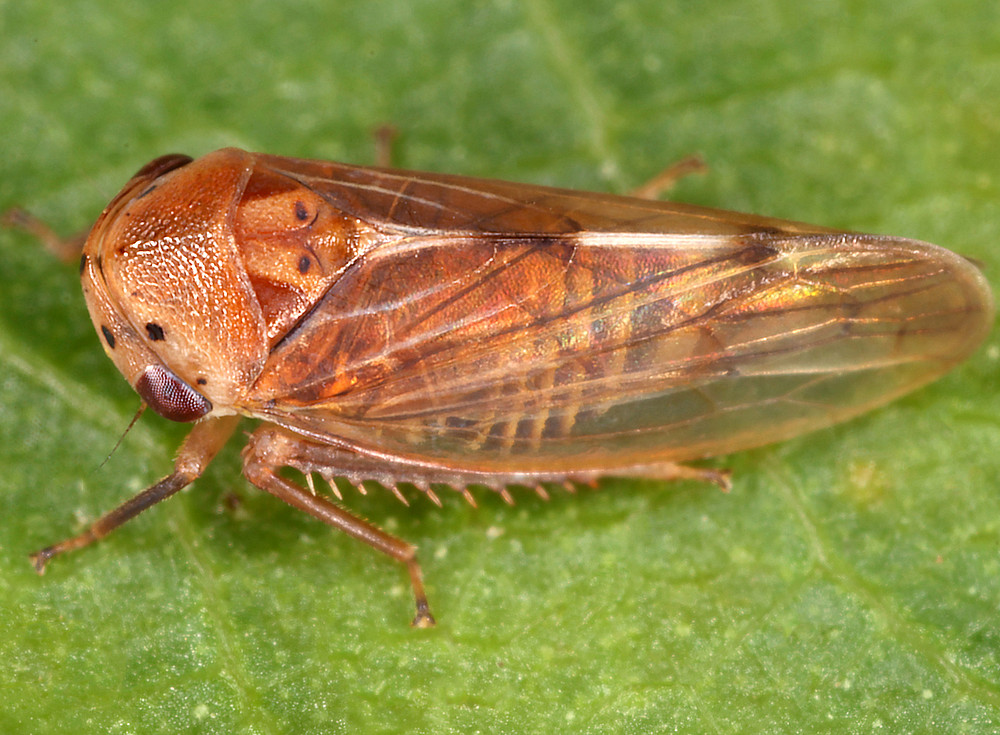
Close-up of an Indian leafhopper (Pediopsoides sharmai) on a green leaf. The insect is shown from the side and has an elongated body with a brown and yellow pattern. The translucent wings reveal fine, dark veins. Several small, dark spots can be seen on the head, and the compound eyes are reddish. The legs are slender and covered with small spines. The background is blurred, clearly highlighting the insect. ©Gernot Kunz
©Gernot Kunz

The Indian leafhopper (Pediopsoides sharmai) feeds on walnut leaves. It is spreading rapidly across Europe.

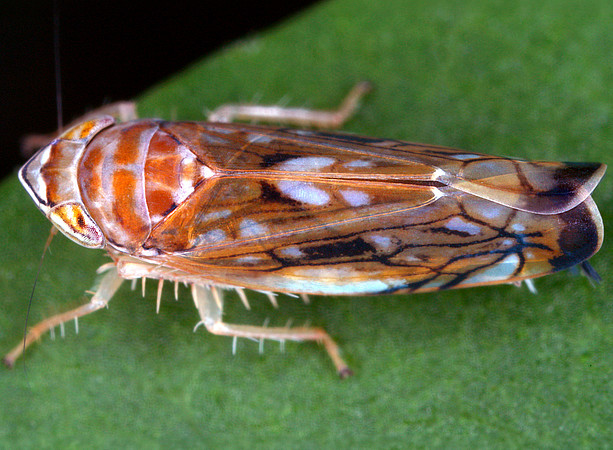
They have travelled to Europe as stowaways via international trade and are now rapidly taking over large parts of the continent: more and more insects from other parts of the world are becoming established here. Biologist Gernot Kunz recently discovered four species for the first time at the University of Graz Botanical Garden: the American grapevine leafhopper (Scaphoideus titanus), the wounded leafhopper from North America (Erasmoneura vulnerata) and the Japanese grape leafhopper (Arboridia kakogawana) – all three specialising in vines – as well as the Indian leafhopper Pediopsoides sharmai, which is associated with walnut trees.


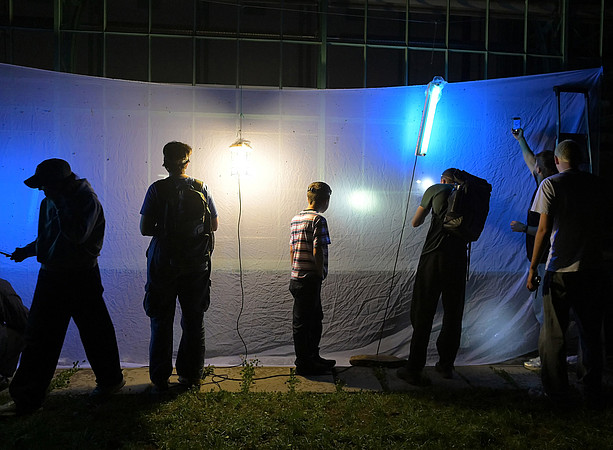
Since 2024, insect expert Gernot Kunz, together with students, has recorded numerous neozoa – the technical term for introduced animal species – in the University of Graz Botanical Garden: 14 different true hoppers, 12 plant lice, nine moths, eight true bugs, seven beetles, five each of Diptera and Hymenoptera, five arachnids, four cockroaches, one millipede and the brown rat. He found the most recent ones this year during an insect night viewing event at the end of May and the end of June, aided by special light traps. In addition, he and students combed through the vegetation using headlamps.

Among the newcomers to the Botanical Garden is the American grapevine leafhopper (Scaphoideus titanus). Kunz first identified it in the Graz urban area seven years ago. It has been known to occur in the area around Klöch/Styria since 2004. Initially introduced to southern Europe, it is spreading further and further north. It has now become a serious threat to wine-growing estates in the southern part of Styria. “By feeding on the vines, it can transmit the flavescence dorée and thus cause the vines to die. However, the leafhopper is significantly more widespread than the pathogen itself,” says the researcher.

Also newly arrived at the Botanical Garden are the wounded leafhopper from North America (Erasmoneura vulnerata) and the Japanese grape leafhopper (Arboridia kakogawana). “Erasmoneura vulnerata sits on the upper surface, whilst Arboridia kakogawana prefers the underside of the leaves, from which they suck the sap. This results in small yellow spots, but does not endanger the vines,” explains Kunz. Both species had already been discovered previously in the Styrian capital. Kunz first recorded the Japanese grape leafhopper in Austria last year in Graz-Puntigam.

The Indian leafhopper (Pediopsoides sharmai) is not interested in grapevines, but feeds exclusively on walnut leaves. It, too, is spreading rapidly. In 2020, it was first sighted in Europe in the Netherlands. This year, Kunz identified it in the Botanical Garden, having previously been spotted in Vorarlberg and Graz-Andritz in 2024.

“Cities are hotspots for species introduced via transport routes before they spread across the country. Around 75 per cent of the non-native species we find in the Botanical Garden travel around the world via the plant trade. This is hardly surprising, as a single clutch of eggs on or in a plant is enough to establish a population,” explains the researcher.

As part of the “City Nature Challenge”, the scientist invites not only students but also nature enthusiasts from the general public every year to search for and document species in the Botanical Garden. The entire site plays an important role for biodiversity: “During an insect night viewing event at the end of May, we discovered over a hundred different species of moths. That’s a very high number for an urban area,” says Kunz happily.


If you are interested in biodiversity, animal and plant habitats, ecology and nature conservation, you can gain in-depth knowledge and discover flora and fauna on field trips during the Biology degree programme at the University of Graz.
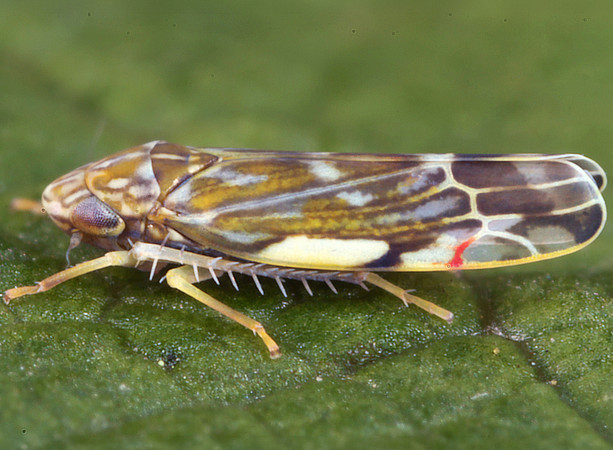
Close-up of a wounded leafhopper from North America (Erasmoneura vulnerata) on a green leaf. The insect is shown from the side; it has an elongated body with yellow-brown and white markings, as well as transparent wings with dark veins. Its legs are yellowish and the leaf in the background is out of focus. ©Gernot Kunz
©Gernot Kunz
Wounded leafhopper from North America (Erasmoneura vulnerata)
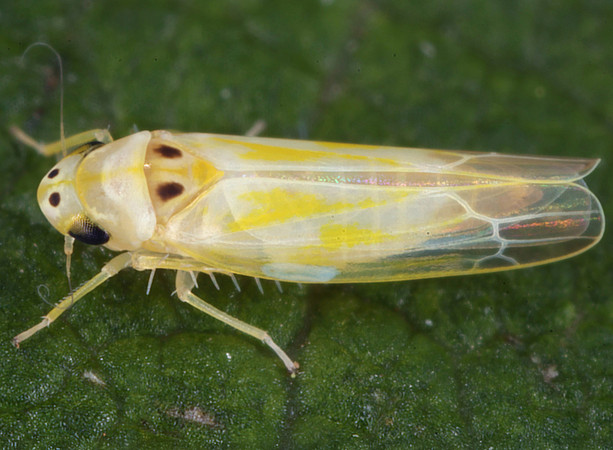
Close-up of a Japanese grape leafhopper (Arboridia kakogawana) on a green leaf. The insect is elongated, predominantly yellowish with translucent wings and dark spots on its head. Its slender legs and wing veins are clearly visible, whilst the background is out of focus. ©Gernot Kunz
©Gernot Kunz
Japanese grape leafhopper (Arboridia kakogawana)
Close-up of an American grapevine leafhopper (Scaphoideus titanus) on a green leaf. The insect is seen from the side, viewed from above; it has an elongated body with a brown and yellow pattern and striking, translucent wings featuring dark and light spots as well as black veins. The legs are light in colour and covered with small spines, whilst the compound eyes are yellowish. The background is blurred, clearly highlighting the insect. ©Gernot Kunz
©Gernot Kunz
The American grapevine leafhopper (Scaphoideus titanus) has become a serious threat to wine-growing estates in the southern part of Styria.
A scientific insect night viewing event: Several people are standing in front of a large white sheet hung up outdoors. The sheet is illuminated by a bright lamp in the centre and a bluish fluorescent tube on the right-hand side. The people are looking at the sheet; some are shining torches or mobile phones onto it. Small insects that have been attracted by the light can be seen on the sheet. Grass is visible in the foreground, and the metal struts of a structure are visible in the background. ©cp-pictures graz
©cp-pictures graz
During an insect night viewing event at the Botanical Garden, students take photographs of the insects attracted by the light traps.
A middle-aged man wearing a dark blue jumper and jeans is standing in the park in front of some trees, his hands in his trouser pockets; the weather is sunny. ©University of Graz / wildundwunderbar
©University of Graz / wildundwunderbar
Gernot Kunz, insect expert at the Department of Biology, University of Graz
created by Gudrun Pichler

Related news

Learning better: Can science experiments in group settings help children with autism?

How can pupils with autism spectrum disorder (ASD) have positive learning experiences and improve their social skills? Researchers at the University of Graz are investigating how science experiments in group settings can contribute to this. Initial results from the project, which is funded by the Austrian Science Fund FWF, show that children react differently depending on the kind of neurodiversity, but that experimentation classes with the right setting definitely have potential. "Pupils with ASD can do more than is currently expected of them in many cases," says project leader Uwe Simon.

Sustainability Award 2024 for two projects of the University of Graz

How do major international conferences reduce their carbon footprint? And what can maths lessons contribute to education for sustainable development? Two questions that were answered at the University of Graz. The corresponding projects were awarded the Sustainability Award 2024 in silver on 26 November in Vienna. This award for Austria's universities and colleges is presented by the Ministry of Science and the Ministry of Climate Protection.

Bees under observation: University of Graz provides unprecedented insights into the hive

What is going on in the combs? How many eggs is the queen laying? How much honey is there? Autonomous robots and AI algorithms provide important data and high-resolution real-time images from inside a beehive. "As part of an international team, we have developed a game-changer technology for a new type of digitalised behavioural research," reports biologist Thomas Schmickl from the Artifical Life Lab at the University of Graz. The publication, which has just appeared as the cover story in the journal "Science Robotics", describes the wealth of information that can be obtained from this unique research facility.

Research for healthy aging: FWF funds Cluster of Excellence "MetAGE" with 18 million euros

Six researchers from the Field of Excellence "BioHealth" at the University of Graz, together with colleagues from the Medical Universities of Graz and Vienna, have acquired an FWF-funded "Cluster of Excellence". Now a newly formed center of excellence will be created under the leadership of the University of Graz. The aim is to gain a better understanding of healthy aging. The findings will flow directly into clinical research.

Begin of page section:
Additional information:

University of Graz
Universitaetsplatz 3
8010 Graz
Austria
  • Contact
  • Web Editors
  • Moodle
  • UNIGRAZonline
  • Imprint
  • Data Protection Declaration
  • Accessibility Declaration
Weatherstation
Uni Graz

End of this page section. Go to overview of page sections

End of this page section. Go to overview of page sections

Begin of page section:

End of this page section. Go to overview of page sections