Begin of page section:
Page sections:

  • Go to contents (Accesskey 1)
  • Go to position marker (Accesskey 2)
  • Go to main navigation (Accesskey 3)
  • Go to sub navigation (Accesskey 4)
  • Go to additional information (Accesskey 5)
  • Go to page settings (user/language) (Accesskey 8)
  • Go to search (Accesskey 9)

End of this page section. Go to overview of page sections

Begin of page section:
Page settings:

English en
Deutsch de
Search
Login

End of this page section. Go to overview of page sections

Begin of page section:
Search:

Search for details about Uni Graz
Close

End of this page section. Go to overview of page sections


Search

Begin of page section:
Main navigation:

Page navigation:

  • University

    University
    • About the University
    • Organisation
    • Faculties
    • Library
    • Working at University of Graz
    • Campus
    Developing solutions for the world of tomorrow - that is our mission. Our students and our researchers take on the great challenges of society and carry the knowledge out.
  • Research Profile

    Research Profile
    • Our Expertise
    • Research Questions
    • Research Portal
    • Promoting Research
    • Research Transfer
    • Ethics in Research
    • Commission for Scientific Integrity
    Scientific excellence and the courage to break new ground. Research at the University of Graz creates the foundations for making the future worth living.
  • Studies

    Studies
    • Prospective Students
    • Students
  • Community

    Community
    • International
    • Location
    • Research and Business
    • Alumni
    The University of Graz is a hub for international research and brings together scientists and business experts. Moreover, it fosters the exchange and cooperation in study and teaching.
Topics
  • Sustainable University
  • Researchers answer
  • Work for us
Close menu

End of this page section. Go to overview of page sections

Begin of page section:
You are here:

University of Graz Natural sciences News Aus eins mach viele: Forschende der Uni Graz identifizieren Mechanismus zur Artentstehung
  • About the faculty
  • Our research
  • Study Service
  • Dean's office
  • Personalities

End of this page section. Go to overview of page sections

Wednesday, 27 May 2026

From one to many: Uni Graz researchers identify a mechanism for the origin of species

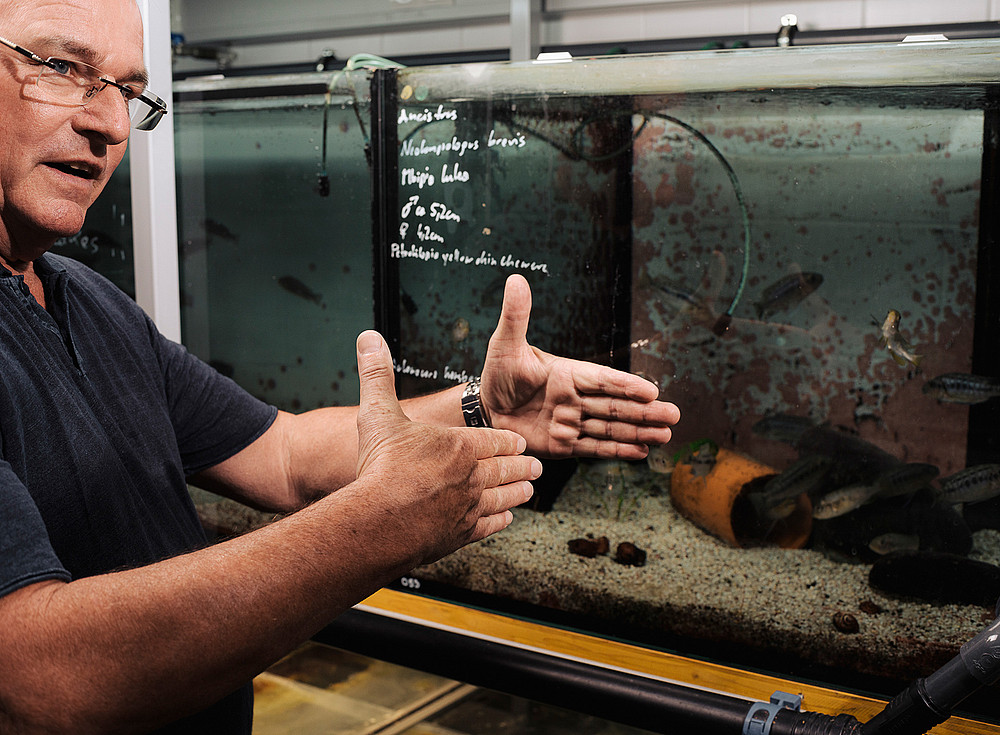
A man wearing glasses and a dark T-shirt is standing in front of an aquarium, gesturing with both hands; fish are swimming in the aquarium. ©Manuel Schaffernak

Evolutionary biologist Christian Sturmbauer is using cichlids to investigate the molecular mechanisms of speciation. Photo: University of Graz/Schaffernak

When a habitat changes, animals, plants and even humans must adapt to the new environmental conditions. Those who manage this fastest and best will prevail. Over time, new species that are specialised for specific habitats also develop. Zoologist Christian Sturmbauer and his research group at the University of Graz, together with international partners, have now demonstrated that the molecular biological process of “alternative splicing” – contrary to previous assumptions – contributes highly effectively to the formation of new species. Different combinations of parts of the same gene give rise to various, structurally slightly different variants of functional proteins. This leads very rapidly to significant changes. The research findings were published in the renowned journal Proceedings of the National Academy of Sciences.


Cichlids in Lake Tanganyika, Lake Malawi and Lake Victoria provide a research environment for the emergence of specialised species that is virtually unrivalled. The three large East African lakes were formed successively by geological subsidence. Cichlids that originally lived in rivers adapted to the new habitats – ranging from deep-water zones and coastal areas to marshy reed beds. In the process, many different species developed, with a similar species community emerging three times independently of one another. And this occurred in what is, in evolutionary terms, a very short period of time. How did this happen?

To answer this question, Christian Sturmbauer and his team selected cichlid species from each lake that occupied the same ecological niche and therefore had similar jaw shapes. In predatory fish, these are elongated, whereas in herbivorous fish they are broader. The zoologists bred these species and compared gene activity in the developing jaws during embryonic development. “Our research revealed that, in an early phase of speciation through adaptation, so-called ‘alternative splicing’ plays a decisive role,” says Sturmbauer, summarising a key finding of the study, and explains: “This process brings about decisive developmental genetic changes surprisingly quickly in order to – as in our case – produce jaw shapes that allow the animals to specialise in specific food sources in their new habitat.” Pooja Singh, first author of the latest publication, made a significant contribution to these findings as part of her doctoral thesis.

Until now, it was widely assumed in the scientific community that alternative splicing variants were of little significance in rapid morphological change. “We were able to show, however, that this is a highly effective mechanism of evolutionary innovation in functional proteins, particularly at the onset of specialisation. Quantitative changes in gene activity only come to dominate at a later stage during further morphological adaptations,” says Sturmbauer.

Cichlids are top-notch when it comes to adaptation. For example, in Lake Victoria, around 500 new species have evolved in a maximum of 16,000 years, species that are found only there. Christian Sturmbauer and his research group at the University of Graz have been conducting highly successful research into the genetic mechanisms of evolutionary innovation in these fish for many years. The extent to which the findings of the current publication apply generally to the emergence of specialised species will need to be clarified by further studies.

Publication
Ancestral splice variation is a key substrate for rapid diversification in African cichlids
Singh, P., Ahi, E.P., Duenser, A., Durdevic, M., Gessl, W., Schaeffer, S., Gallaun, J., Seehausen, O., and Christian Sturmbauer
PNAS, 12 May 2026, 123 (20) e2516477123, https://doi.org/10.1073/pnas.251647712
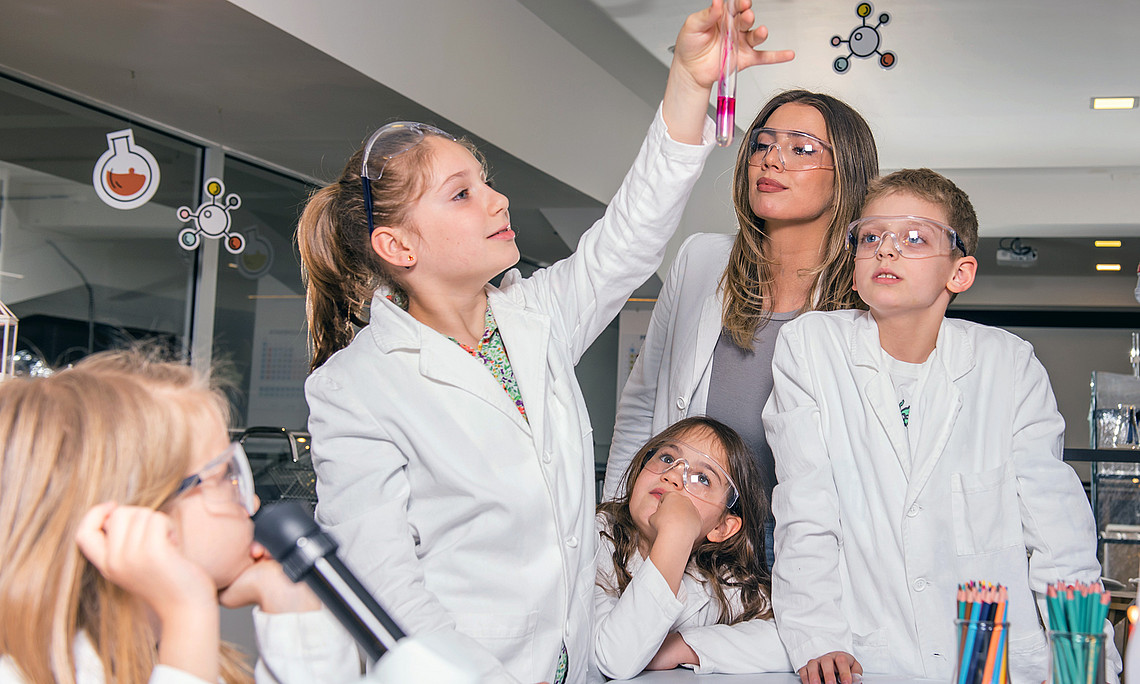

 

Anyone interested in the interrelationships between all living things will gain a deeper understanding of the wonders of nature, both in theory and in practice, through a degree in biology.

created by Gudrun Pichler

Related news

Learning better: Can science experiments in group settings help children with autism?

How can pupils with autism spectrum disorder (ASD) have positive learning experiences and improve their social skills? Researchers at the University of Graz are investigating how science experiments in group settings can contribute to this. Initial results from the project, which is funded by the Austrian Science Fund FWF, show that children react differently depending on the kind of neurodiversity, but that experimentation classes with the right setting definitely have potential. "Pupils with ASD can do more than is currently expected of them in many cases," says project leader Uwe Simon.

Sustainability Award 2024 for two projects of the University of Graz

How do major international conferences reduce their carbon footprint? And what can maths lessons contribute to education for sustainable development? Two questions that were answered at the University of Graz. The corresponding projects were awarded the Sustainability Award 2024 in silver on 26 November in Vienna. This award for Austria's universities and colleges is presented by the Ministry of Science and the Ministry of Climate Protection.

Bees under observation: University of Graz provides unprecedented insights into the hive

What is going on in the combs? How many eggs is the queen laying? How much honey is there? Autonomous robots and AI algorithms provide important data and high-resolution real-time images from inside a beehive. "As part of an international team, we have developed a game-changer technology for a new type of digitalised behavioural research," reports biologist Thomas Schmickl from the Artifical Life Lab at the University of Graz. The publication, which has just appeared as the cover story in the journal "Science Robotics", describes the wealth of information that can be obtained from this unique research facility.

Research for healthy aging: FWF funds Cluster of Excellence "MetAGE" with 18 million euros

Six researchers from the Field of Excellence "BioHealth" at the University of Graz, together with colleagues from the Medical Universities of Graz and Vienna, have acquired an FWF-funded "Cluster of Excellence". Now a newly formed center of excellence will be created under the leadership of the University of Graz. The aim is to gain a better understanding of healthy aging. The findings will flow directly into clinical research.

Begin of page section:
Additional information:

University of Graz
Universitaetsplatz 3
8010 Graz
Austria
  • Contact
  • Web Editors
  • Moodle
  • UNIGRAZonline
  • Imprint
  • Data Protection Declaration
  • Accessibility Declaration
Weatherstation
Uni Graz

End of this page section. Go to overview of page sections

End of this page section. Go to overview of page sections

Begin of page section:

End of this page section. Go to overview of page sections